
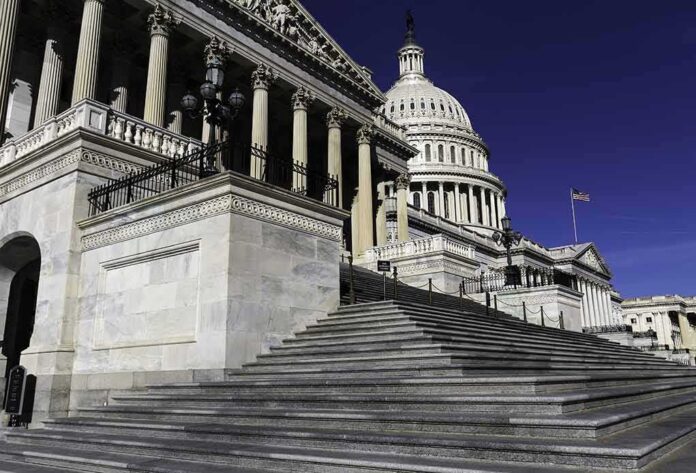
President Trump’s new order tells federal contractors to protect confidential White House communications before talking to Congress, drawing clear lines around executive privilege.
Story Highlights
- The order anchors executive privilege in the Constitution’s separation of powers.
- Contractors must notify the White House and agencies about congressional requests.
- Only requests with a valid legislative purpose should proceed, not ones intruding on core executive work.
- Media critics call it a curb on oversight; the White House says it guards sensitive decision-making.
What President Trump’s Order Actually Does
White House text says executive privilege protects confidential executive-branch information and is rooted in the Constitution’s separation of powers. The order directs federal contractors to notify the White House and their contracting agency when Congress asks for information. It requires coordination on how to respond and to follow instructions if the administration determines certain materials are privileged. The structure uses government contracting rules, not informal guidance, to ensure compliance across companies working with the executive branch.
White House materials say the goal is to let presidents and senior advisers work with staff and contractors without fear that private advice will leak on demand. That includes work products and communications tied to policy choices and national leadership. By routing requests through an orderly process, the administration argues it can respect lawful inquiries while shielding confidential advice needed for sound decisions. That balance, officials say, reflects long-standing executive privilege principles applied to today’s contractor-heavy government.
How the Order Draws a Line on Congressional Demands
The order says Congress must show a valid legislative purpose and avoid intruding on core executive functions when demanding information from agencies, employees, or contractors. This echoes historic practice where the branches bargain and narrow disputes rather than dump raw files. Most privilege fights do not end in court rulings. They resolve through negotiation, redactions, and accommodations, because the law here is narrow and case-specific. That tradition of careful limits is what the order tries to codify for contractor-held material.
The directive sets an initial screening process inside the executive branch, even when a third-party contractor holds records. Contractors are told to alert the White House and follow instructions for any materials officials deem privileged. Reporting notes that critics see risk in this design. They argue it could delay or deter cooperation. Some outlets say noncompliance could lead to contract cancellation or lost future work, creating pressure to defer to the White House while disputes play out.
Criticism, Risks, and What Is Still Unclear
Democratic lawmakers Rep. Jamie Raskin and Rep. Robert Garcia claim the order is unprecedented and attacks Congress’s oversight role. They say contractors have a duty to speak truthfully when Congress asks. Major outlets frame the move as a restriction on access, not only a privilege shield. At the same time, the White House cites the real need to protect sensitive deliberations, including when contractors support policy planning, procurement strategy, or national-security tasks that rely on confidential advice.
Key gaps remain. The order does not spell out a detailed test that separates privileged advice from ordinary performance data. It does not lay out a neutral review process if a contractor or committee disputes a privilege call. It does not specify how mixed records will be handled or logged for later court review. Those open items suggest more guidance will be needed, likely through agency clauses, acquisition rules, and on-the-record instructions that preserve whistleblower protections and lawful reporting channels.
Sources:
cbsnews.com, reuters.com, whitehouse.gov, us.cnn.com, bloomberg.com, npr.org, thehill.com, fresnobee.com