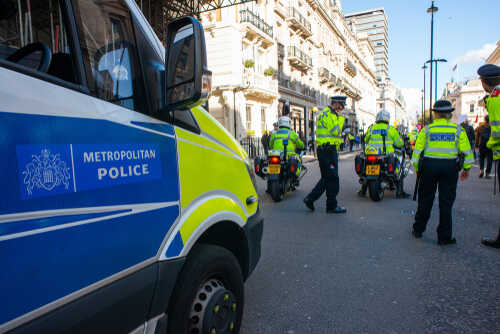
British police have drawn a new red line on pro-Palestine protests, raising hard questions about free speech, public safety, and how far Western governments will bend before confronting homegrown extremism. Following a deadly terror attack on a Hanukkah event in Sydney’s Bondi Beach, Metropolitan and Greater Manchester Police announced that chanting “globalise the intifada” can now lead to arrest at UK demonstrations. This clear policy shift, welcomed by Jewish security groups as overdue protection, is viewed by civil-liberties advocates as part of a wider crackdown, highlighting the clash between counter-terrorism, rising antisemitism, and Western commitments to free expression.
Story Snapshot
- Metropolitan and Greater Manchester Police now say chanting “globalise the intifada” can lead to arrest at UK protests.
- Police cite a changed security climate after a deadly terror attack on a Hanukkah event in Sydney’s Bondi Beach.
- Jewish security groups welcome the move as overdue protection; civil‑liberties groups call it part of a wider crackdown.
- The dispute highlights the clash between counter‑terrorism, rising antisemitism, and Western commitments to free expression.
Police Draw a New Line on Protest Speech
The Metropolitan Police in London and Greater Manchester Police have jointly announced that protesters who chant “globalise the intifada” at demonstrations, or use it in a targeted way, should now expect arrest. This is a clear policy shift. For months, UK authorities had tolerated controversial pro‑Palestine slogans, saying they did not reliably meet the criminal bar for incitement or terrorism offences. Now, police leaders say the threat environment has changed and their posture must change with it.
Police chiefs frame this as a law‑and‑order decision rooted in public safety, especially for Jewish communities. They say front‑line officers will be briefed and empowered to use Public Order Act powers, including setting conditions around synagogues during services. By publicly singling out one chant, rather than using vague language about extremism, the Met and Greater Manchester Police are signalling that certain words now cross a threshold from protected political speech into potential criminal conduct.
UK police announce they'll arrest people holding placards and chanting “globalise the intifada,” a slogan that's been used to call for international support of Palestinian resistance against Israeli occupation and its genocide in Gaza.
🔴 LIVE updates: https://t.co/KHobh1GCj6 pic.twitter.com/3fnThxpaag
— Al Jazeera English (@AJEnglish) December 17, 2025
From Sydney Bloodshed to UK Crackdown
The immediate trigger for this tougher line is a terror attack thousands of miles away. At a Hanukkah celebration in Sydney’s Bondi Beach area, gunmen opened fire on a crowd of more than 1,000 people, killing 15 during a Jewish festival event. Australian authorities charged surviving suspect Naveed Akram with multiple counts of murder and terrorism offences, while his father died at the scene after being shot by police. That carnage now directly shapes how British police read protest slogans on UK streets.
Police leaders argue that “context has changed” after Bondi and other recent attacks affecting Jewish communities, including in the UK. They claim that chants which might previously have been treated as political hyperbole must be reassessed when Jewish families feel hunted worldwide. Jewish security charity Community Security Trust and Chief Rabbi Sir Ephraim Mirvis strongly back this reasoning, calling it intolerable to hear calls for a “global intifada” amid a wave of violence against Jews. To them, the Sydney shooting proves that rhetoric can spill into real‑world bloodshed.
What “Intifada” Means—And Why It Divides
The heart of the dispute is the word “intifada” itself. Literally meaning “to shake off” in Arabic, the term became globally known through the First and Second Palestinian Intifadas between 1987 and 2005. Those uprisings mixed mass protests and civil disobedience with shootings, bombings, and suicide attacks that left many Israelis dead. As a result, many Jews, Israelis, and security agencies hear “intifada” as shorthand for violent insurgency and terrorism, not just generalized resistance or decolonisation rhetoric.
Pro‑Palestine activists insist the phrase “globalise the intifada” is about spreading solidarity with Palestinians and challenging what they call colonial systems worldwide, not about attacking Jewish civilians. Human‑rights groups, already alarmed by mass arrests linked to the UK’s terrorist designation of “Palestine Action,” warn that criminalising a slogan blurs the line between objectionable speech and genuine incitement. For American conservatives who watched years of “mostly peaceful” riots excused at home, the UK debate feels familiar: who decides which slogans are treated as political expression and which trigger handcuffs.
Escalating Crackdown on Palestine‑Linked Activism
The new chant policy does not stand alone; it fits into a broader clampdown on Palestine‑related activism across the UK. The government recently proscribed direct‑action group Palestine Action as a terrorist organisation, prompting a wave of protests coordinated by the Defend Our Juries network. Since the ban took effect, police have arrested more than 2,700 people, including over 600 in less than two weeks during peaceful actions challenging the proscription and defending jury independence in terrorism cases.
Many of those detainees now face terrorism‑related charges for acts as simple as carrying signs stating “I Oppose Genocide. I Support Palestine Action.” Amnesty International argues that using counter‑terrorism powers in this way violates basic rights to freedom of expression and peaceful assembly. When authorities go from targeting bomb‑makers to targeting placards and chants, critics see not just a security response but an attempt to police political narratives. For constitutional conservatives in the US, that looks uncomfortably close to the speech‑policing and “hate‑crime” expansion pushed by Western elites for years.
Security, Censorship, and Lessons for American Patriots
British Jewish groups emphasise that their communities have seen a sharp rise in antisemitic incidents since the Gaza war began, and they welcome any step that pushes violent rhetoric back from synagogue doors. At the same time, civil‑liberties advocates warn that once governments normalise arresting people over slogans, the tool will not stay confined to one conflict. The same logic can be turned against Christian conservatives, Trump supporters, or anyone branded an “extremist” by a hostile bureaucracy.
For American readers who lived through Big Tech censorship, “disinformation” crackdowns, and selective prosecution under the previous administration, the UK situation is a cautionary tale. Western governments face real terror threats; protecting innocent life is non‑negotiable. But when authorities respond by lowering speech thresholds and leaning on broad terrorism laws, they risk eroding the very liberties they claim to defend. Patriots who cherish the First Amendment should watch closely—because what starts with foreign slogans on London streets rarely ends there.
Watch the report: Arrests to be made for chanting ‘globalise the intifada’, police chiefs say
Sources:
Pro-Palestine protesters chanting ‘globalise the intifada’ in the UK face arrest, police confirm
United Kingdom: Over 600 More Arrests Made at Peaceful Protests
Two arrested after police say they will act against intifada chants
Police will arrest protesters who chant ‘globalise the intifada’