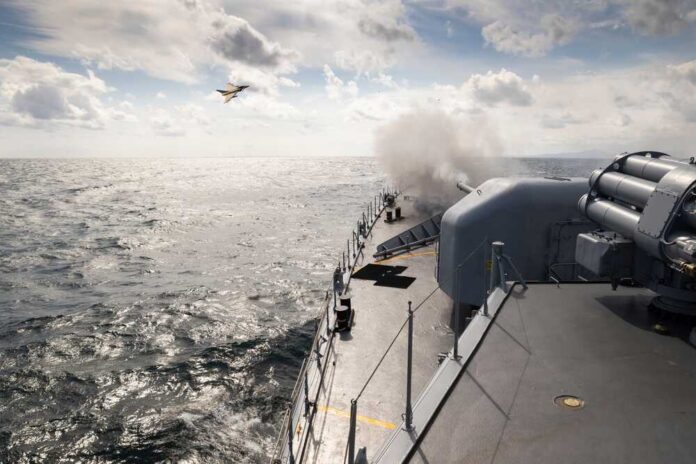
President Trump ordered an immediate naval blockade of the Strait of Hormuz after Iran refused to abandon its nuclear weapons program during 21 hours of failed peace talks in Pakistan, threatening the world’s most critical oil chokepoint and potentially triggering a global energy crisis.
Story Snapshot
- Trump announced via Truth Social that the U.S. Navy will blockade all ships entering or leaving the Strait of Hormuz, which carries 20% of the world’s oil supply
- Peace talks collapsed Saturday after Iran rejected U.S. demands to abandon nuclear ambitions, despite agreement on most other negotiation points
- U.S. Central Command confirmed blockade operations begin Monday at 10:00 a.m. ET, targeting Iranian port traffic and vessels paying Iran’s extortion tolls
- Iran’s Revolutionary Guard Corps warned the blockade violates the fragile ceasefire and promised a forceful response to approaching U.S. vessels
- The escalation threatens global oil markets and risks reigniting full-scale war between the U.S. and an already militarily devastated Iran
Diplomatic Breakdown After Marathon Talks
Vice President J.D. Vance led U.S. negotiators through 21 hours of intense discussions in Islamabad, Pakistan, seeking to end ongoing hostilities and secure lasting peace with Iran. The talks ended late Saturday night when Iranian officials refused to provide what Vance called an “affirmative commitment” to abandon nuclear weapons development. Despite progress on multiple agenda items, the nuclear issue proved insurmountable. Vance confirmed Iran “chose not to accept our terms” while leaving the door open for future diplomacy, stating the American proposal remains simple and available whenever Iran decides to engage seriously on denuclearization.
Trump’s Blockade Announcement and Military Orders
Trump delivered his blockade declaration Sunday morning through Truth Social, accusing Iran of “world extortion” through tolls imposed on vessels transiting the Strait of Hormuz and mines laid throughout the critical waterway. The president ordered U.S. naval forces to interdict any ship paying Iranian tolls, destroy all mines in the strait, and prepare to retaliate with overwhelming force against Iranian military assets. Trump warned that any Iranian vessel or installation threatening American forces would be “blown to hell,” emphasizing U.S. military dominance after previous conflict decimated Iran’s navy, air force, and anti-aircraft capabilities. A carrier strike group deployment commenced immediately to enforce the blockade.
Iran’s Extortion Scheme at Global Chokepoint
The Strait of Hormuz, a 21-mile-wide passage between Iran and Oman, serves as the world’s most vital oil transit route, channeling approximately one-fifth of global petroleum supplies. Iran exploited this strategic advantage by imposing tolls on commercial shipping and laying mines throughout the waterway, selectively allowing allied nations favorable access while extracting payments from others. Trump characterized this behavior as extortion on a global scale, noting that Iran’s sixth demand in peace negotiations explicitly sought recognition of its right to control strait passage. The U.S. position demands free navigation through international waters without Iranian interference, a principle Trump stated he would enforce through naval power if diplomacy fails.
Military Realities and Escalation Risks
Trump’s announcement referenced Iran’s severely weakened military condition following previous U.S. operations that eliminated Iranian naval forces, destroyed air defenses, and killed senior leadership. Despite these losses, Iran’s Revolutionary Guard Corps issued warnings that approaching U.S. vessels would violate the existing two-week ceasefire and face “severe force” in response. U.S. Central Command confirmed blockade operations would begin Monday morning, specifically targeting Iranian port traffic while clearing mines and interdicting toll-compliant vessels. Analysts warn the blockade could be perceived as an act of war, potentially shattering the fragile ceasefire and reigniting full-scale conflict with unpredictable regional consequences and certain economic disruption.
The blockade represents a calculated gamble that economic pressure will force Iran to abandon nuclear ambitions where diplomacy failed. Trump acknowledged oil prices would rise “a little bit higher” but framed the action as necessary to end Iranian extortion and nuclear threats. Global energy markets face immediate uncertainty as one-fifth of oil supplies potentially face disruption, affecting importers throughout Asia, Europe, and beyond. Shipping companies and energy firms must navigate interdiction risks and increased insurance costs while regional powers including Oman, the United Arab Emirates, and Saudi Arabia confront heightened tensions at their doorstep. Whether this pressure forces Iranian concessions or triggers broader Middle Eastern conflict remains uncertain as Monday’s blockade commencement approaches.
Sources:
Fox News: US-Iran Vance Strait of Hormuz Live Updates – April 12
Time: Trump Blockade Strait of Hormuz Iran
The Times: Trump US Blockade Iran Peace Talks Fail