America is surging a third aircraft carrier toward the Iran fight—not to show off strength, but because the Navy is stretching its limited options to keep the pressure on.
Quick Take
- The USS George H.W. Bush is preparing to deploy as a third U.S. carrier presence tied to operations against Iran.
- Two carriers were already in the region, but the USS Gerald R. Ford required pierside repairs after an internal fire, creating a capability gap.
- About 40% of America’s aircraft carriers being concentrated in one theater signals strain on readiness and global coverage.
- Official justifications for strikes have faced scrutiny after reports of disagreement between administration claims and at least one Pentagon assessment shared with Congress.
Third Carrier Movement Reflects Sustainment Pressure, Not Just Signaling
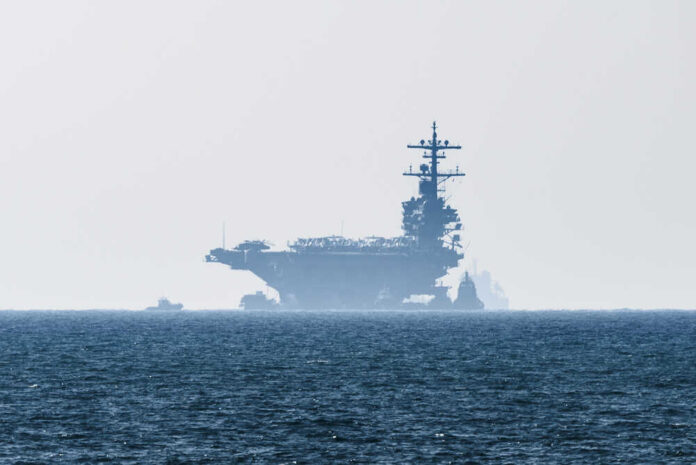
U.S. preparations to send the USS George H.W. Bush toward the Eastern Mediterranean put a third carrier in play as operations against Iran continue. It indicates the ship completed preparations off North Carolina’s Hatteras Island and is expected to embark with guided-missile destroyers. In practical terms, carriers are not interchangeable “props”; they are rotating, maintenance-heavy systems. When Washington reaches for another carrier, it often indicates the current posture is difficult to sustain.
The timeline shows how fast the carrier demand has grown. The USS Abraham Lincoln arrived in CENTCOM’s area by late January 2026, and the USS Gerald R. Ford was reported en route in mid-February. By late February, the Ford was operating off Israel as joint U.S.-Israel strikes on Iran were carried out. Within days, reports emerged that the Bush could be next, a pattern that points to operational requirements overtaking normal force rotations.
Two Carriers on Paper, But Maintenance and Fires Change the Math
As of March 2026, it described two U.S. carriers as operational in the region: the Ford and the Lincoln. That headline number matters politically, but military availability depends on real-world readiness. The Ford later required pierside repairs following an internal fire, and the Bush was described as a potential replacement considered for the operation. When a carrier is in repair, commanders lose sortie generation, flexibility, and the deterrent value that comes from being able to surge aircraft quickly.
Carrier strain is also measured in time at sea and the human toll. The Ford’s deployment reportedly began in late June 2025, producing an unusually long stretch by early 2026. Extended deployments affect training cycles, retention, maintenance backlogs, and family stability for service members—issues many Americans recognize from two decades of high-tempo operations. The conservative case for readiness starts with honesty: a military pushed past sustainable rotations eventually pays in accidents, fatigue, and weakened deterrence.
Forty Percent of U.S. Carriers in One Theater Leaves Other Risks Uncovered
One of the starkest data points in the reporting is that roughly 40% of available U.S. aircraft carriers were committed to the Iran war effort. That concentration may be necessary in the short term, but it also reduces America’s ability to respond elsewhere. Carrier strike groups are not just regional assets; they are the backbone of global crisis response. When nearly half are tied down, adversaries can test U.S. resolve in other theaters simply because the margin for rapid reinforcement shrinks.
The support footprint underscores how “all in” the posture has become. To extend the range of carrier air operations, the U.S. deployed Air Force refueling tankers to Israel’s Ben Gurion Airport. That kind of logistics web can enhance striking power, but it also expands the number of targets and political flashpoints tied to the operation. For voters wary of open-ended commitments, the key question is not whether American power can be projected, but how long it can be sustained without degrading readiness.
Strikes, Retaliation, and Conflicting Intelligence Claims Complicate Oversight
Reporting on the February strikes described severe casualties, including more than 1,000 killed, among them Iran’s Supreme Leader Ali Khamenei and more than 150 schoolgirls, along with senior officials. Iran responded with broad retaliatory barrages aimed at U.S. bases, diplomatic facilities, personnel, and Israeli cities. Those facts show the stakes are real and immediate. At the same time, casualty reporting and breakdowns remain limited in public sources, leaving gaps that should be answered clearly.
Oversight concerns sharpened around the administration’s stated rationale for action. The Trump administration said Iran had restarted its nuclear program and was developing missiles with range to threaten the United States. Reports also said Trump authorized strikes after receiving intelligence of Iranian plans for preemptive missile launches. Yet the same reporting noted an unspecified Pentagon source briefed Congress that no intelligence suggested Iran planned to attack U.S. forces first, raising questions about how claims were assessed and presented.
Diplomacy Timelines Haven’t Matched Reality, So the Military Carries the Load
President Trump publicly suggested in February 2026 that a nuclear deal could happen within about a month and that Iran should “agree very quickly.” By March, reporting still framed the situation as an ongoing war posture requiring more naval power, not a winding-down phase. When diplomatic breakthroughs do not arrive on schedule, commanders are left sustaining deterrence and strike capacity day after day. That dynamic is how “temporary” deployments turn into long, exhausting rotations.
A Third U.S. Aircraft Carrier Is Heading to the Iran War — It’s Not an Escalation Signal, It’s a Sign America Is Running Out of Optionshttps://t.co/TxP7WSEQJw
— 19FortyFive (@19_forty_five) March 22, 2026
The strategic takeaway is straightforward: a third carrier can look like escalation, but the available facts also support a more sobering interpretation—America is compensating for maintenance realities, long deployments, and a high operational tempo. Conservatives who care about constitutional accountability should watch two things closely: whether Congress receives clear, consistent intelligence justifications, and whether the Pentagon can keep readiness intact while concentrating so much naval power in one region for an extended period.
Sources:
US preparing to deploy 3rd aircraft carrier to region for strikes on Iran
Second US aircraft carrier being sent to Middle East, source says, as Iran tensions high
Tracking US military assets in the Iran war
Navy Juggles Its Aircraft Carrier Plans To Stay Afloat
US preparing to deploy 3rd aircraft carrier to region for strikes on Iran