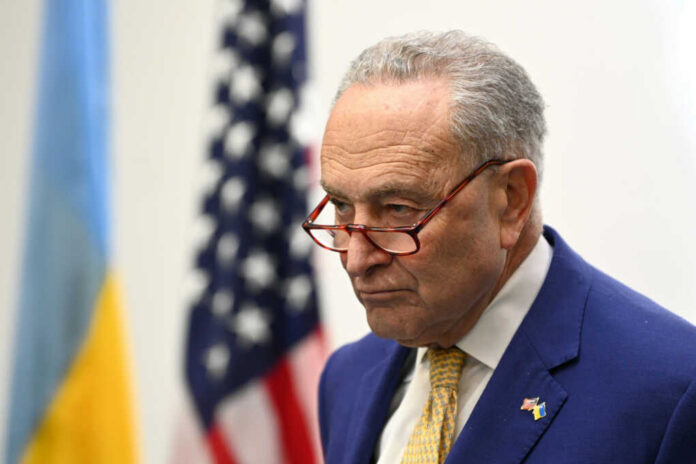
Senate Minority Leader Chuck Schumer blasts President Trump’s Iran war as a catastrophic failure that strengthened America’s enemies and spiked gas prices for families, demanding Congress seize control.
Story Highlights
- Schumer declares on April 8, 2026, the war left U.S. worse off, bolstering Iran’s regime and nuclear ambitions while disrupting the Strait of Hormuz.
- Two-week ceasefire touted by Trump as peace victory, but Schumer calls it insufficient amid elevated energy costs hitting American wallets.
- Senate Democrats plan war powers vote next week to limit Trump’s military actions and reassert congressional authority.
Schumer’s Sharp Critique of Iran War
On April 8, 2026, Senate Minority Leader Chuck Schumer held a press conference and Senate address condemning President Trump’s handling of the U.S.-Iran war. He stated the conflict made America worse off than before it started. Iranian forces gained control over the Strait of Hormuz, a vital chokepoint for 20-30% of global oil shipments. The regime strengthened, nuclear ambitions went unchecked, gas prices soared for U.S. families, and American credibility suffered abroad. Schumer positioned this as one of Trump’s worst foreign policy failures.
Ceasefire Context and Escalation Timeline
The war escalated before April 8 from Iranian disruptions in the Strait of Hormuz, prompting Trump administration military responses without a clear congressional strategy or endgame. Recently, U.S. and Iran agreed to a two-week ceasefire, which Trump hailed as a big day for world peace. Schumer dismissed this as inadequate, noting persistent Hormuz issues and unresolved threats. This echoes past tensions like Trump’s 2018 nuclear deal withdrawal and the 2020 Soleimani strike, amid broader Middle East volatility involving Israel.
Upcoming Senate War Powers Vote
Schumer announced a Senate vote next week on a war powers resolution under the 1973 War Powers Resolution to curb the conflict and reassert Congress’s role. Democrats aim to limit executive overreach in military engagements. With Republicans controlling both chambers in Trump’s second term, passage faces hurdles, intensifying partisan divides. Schumer motivates his caucus through critiques framing the war as impulsive and damaging to U.S. interests.
U.S. troops remain deployed in the Middle East, facing risks, while American families bear higher energy costs from oil market instability. Schumer highlights these domestic burdens to underscore strategic setbacks.
Impacts on Americans and Power Dynamics
Short-term effects include fragile ceasefire risks, troop deployment uncertainties, and oil price volatility pinching household budgets. Long-term, Schumer warns of an emboldened Iranian regime under Ayatollah Khamenei, eroded U.S. global standing, and years to repair damage. War fatigue grows among Americans tired of endless conflicts. Political pressures mount on Trump as Democrats leverage the issue, revealing deep government divisions where elites prioritize power over citizen welfare.
Both conservatives frustrated by high energy costs from past policies and liberals wary of unchecked executive wars share distrust in federal failures. This underscores how partisan battles sideline the American Dream, fueling calls for accountability amid elite entrenchment.