
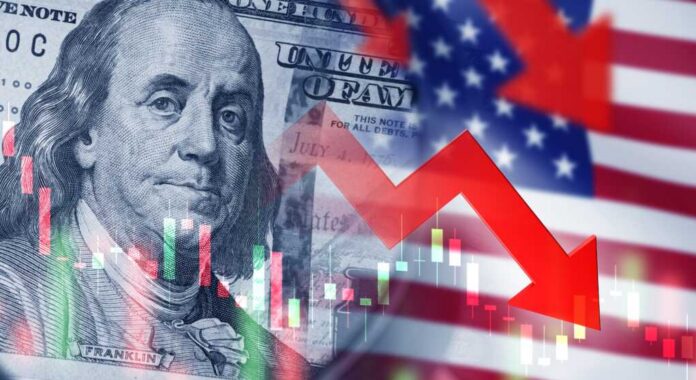
Consumer sentiment has hit near-record lows while the stock market hovers close to all-time highs — a contradiction that reveals something important about how the economy actually works, and why everyday Americans are right to feel confused.
Story Snapshot
- University of Michigan consumer sentiment fell to 50.8, the second-lowest reading on record, even as the S&P 500 sat less than 4% below its all-time high.
- April inflation dropped to 2.3%, its lowest level since 2021, offering real evidence that price pressures are easing under current policy.
- Spending data tells a different story than surveys — consumer expenditures and same-store sales remain consistent with historical expansion trends.
- Investment analysts warn that sentiment surveys are coincident indicators, not predictors, meaning they move with the market rather than forecasting where it goes next.
Markets Rise While Mood Craters
The gap between how Americans feel and what financial markets are doing has rarely been wider. The University of Michigan’s consumer sentiment index registered 50.8 in May 2026 — the second-lowest reading ever recorded — while the S&P 500 finished the same week less than 4% below its all-time high. That is not a rounding error or a media distortion. It is a genuine and striking divergence that demands a real explanation, not a political talking point from either side. [1]
Part of the explanation lies in what the stock market actually measures. Equity prices are forward-looking claims on future corporate earnings and expected interest-rate policy — not a live poll on how families feel at the grocery store. When inflation data comes in softer than expected, as it did for the third consecutive month in April, markets respond to the implication that the Federal Reserve may ease policy sooner. That rational repricing can lift stocks even while households still feel the accumulated sting of years of elevated prices. [1]
Inflation Is Easing, But Memories Are Long
April’s Consumer Price Index (CPI) headline inflation fell to 2.3%, the lowest since 2021, and came in below expectations for the third month running. Businesses had front-loaded inventory purchases ahead of tariff implementation, which helped cushion immediate price increases at the consumer level. That buffer has kept the latest inflation print from spiking, even though one-year inflation expectations in surveys remain elevated at 7.3% — a sign that Americans are still bracing for pain they have not yet fully seen at the register. [1]
This gap between actual inflation and expected inflation is crucial. Sentiment surveys capture anxiety and memory as much as present conditions. Years of post-pandemic price surges burned households in ways that a few months of softer CPI readings cannot quickly erase. Consumers who watched grocery bills, rent, and energy costs climb sharply are not going to celebrate a 2.3% headline number when their budgets still reflect the cumulative damage of the prior surge. That frustration is legitimate and should not be dismissed. [3]
Spending Says One Thing, Surveys Say Another
Hard behavioral data complicates the doom-and-gloom sentiment narrative. Consumer expenditures rose 2.4% and business investment climbed 3.8%, figures consistent with an expanding economy rather than a contracting one. Sage Advisory reports that same-store retail sales were up 7.6% year-over-year, and a record 203 million consumers shopped in-store or online over Thanksgiving weekend. People may feel pessimistic, but they are still opening their wallets — a pattern that has persisted even as survey readings have cratered. [2] [5]
The stock market has never been so good, while people have felt so bad!
Despite record highs — S&P 500 near all-time highs and strong gains — American consumer sentiment is at its lowest level in decades.
People are worried about inflation, weakening job market, and high prices,… pic.twitter.com/nPJP6xfKZS— Dr. Rakesh Bansal (@iamrakeshbansal) May 25, 2026
Investment analyst Ken Fisher has argued directly that consumer sentiment is a coincident indicator — meaning it tends to move alongside the stock market rather than predict where it goes next. In his view, weak sentiment readings are not a reliable warning signal for equities. That interpretation aligns with what the data currently show: spending is holding up, inflation is retreating, and markets are pricing in continued improvement. [4] The honest takeaway is that both things are true simultaneously — real economic progress is occurring, and real household frustration is also valid. Americans who feel left behind by a “K-shaped” recovery, where asset owners benefit while wage earners struggle, are not wrong to be skeptical of index highs that do not show up in their bank accounts.
What the Disconnect Really Means
The divergence between sentiment and markets is not new, but the current gap is historically extreme. Plante Moran noted that September 2025 consumer sentiment readings were among the weakest in seven decades — more consistent with recession than with nearly 4% quarterly GDP growth. That kind of mismatch suggests sentiment is being driven by factors beyond pure economic calculation: inflation psychology, political identity, media framing, and the lived experience of cost burdens that official averages can obscure. [3]
For conservatives who have watched Washington spend recklessly, import inflation through energy restrictions, and gaslight working families about the cost of living, the skepticism embedded in those sentiment numbers makes complete sense. The market may be recovering and inflation may be retreating, but trust — once broken by years of policy mismanagement — does not rebound on a single data release. The numbers are improving. The scars from when they were not remain very real. [2]
Sources:
[1] Web – Weaker consumer confidence dampens a good week for stocks
[2] Web – Economic Sentiment Belies Strong Economic Estimates – RIA
[3] Web – Consumer sentiment remains unusually weak despite solid …
[4] YouTube – Record Low Consumer Sentiment Isn’t What Many Investors Think
[5] Web – More Than a Feeling: The Disconnect Between Consumer …