France and the UK are deploying warships to the Strait of Hormuz just as the brutal US-Iran conflict appears to reach its endgame, raising serious questions about whether these European allies are arriving to help secure peace or simply to claim a stake in the spoils after America shouldered the burden of war.
Story Snapshot
- UK and France dispatch naval forces to the Strait of Hormuz following a 51-nation Paris summit, declaring a “strictly defensive” mission separate from ongoing US operations
- The deployment comes as the US maintains an active blockade against Iran with no confirmed ceasefire, trapping approximately 1,500 commercial vessels and 20,000 sailors in the strait
- The Strait of Hormuz handles roughly 20% of global oil trade, making its closure a critical driver of worldwide energy price spikes and economic instability
- Critics characterize the European intervention as opportunistic timing—positioning for post-war influence over shipping lanes after the US absorbed months of combat losses
Allied Warships Deploy as US Blockade Continues
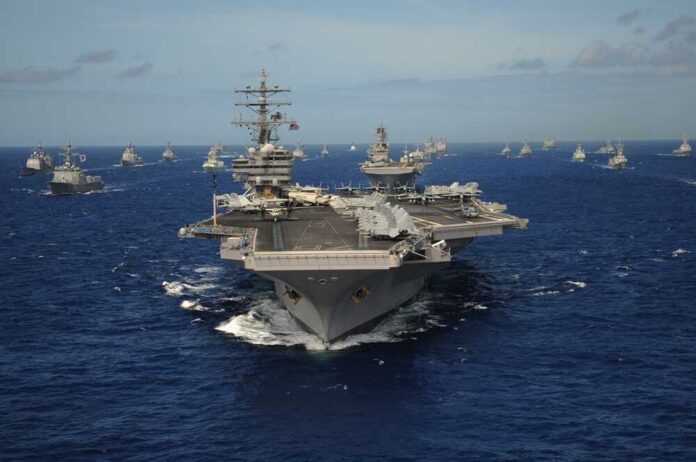
The UK dispatched HMS Dragon, a Type 45 destroyer, toward the Middle East in late April 2026, while France redirected its Charles de Gaulle carrier group and accompanying frigates from Mediterranean and Red Sea stations. These movements followed an April 17 summit in Paris where British Prime Minister Keir Starmer and French President Emmanuel Macron announced plans for a multinational mission to restore shipping through the strait. Despite the European proclamation of a defensive posture, US Central Command maintains an active naval blockade against Iran with ongoing military clashes, contradicting assumptions that hostilities are winding down.
Energy Chokepoint Holds Global Economy Hostage
The Strait of Hormuz, a mere 21-mile-wide passage between Iran and Oman, served as the transit route for approximately 21 million barrels of oil daily before the current conflict. Iran’s blockade of the waterway in response to US military pressure has created a cascading crisis affecting global energy markets, fertilizer supplies, and food security—particularly devastating nations in Asia and the developing world. An Iranian adviser declared the regime views control of Hormuz as equivalent to possessing an atomic bomb, signaling Tehran’s determination to maintain leverage regardless of diplomatic overtures from European powers or international shipping organizations.
Fairweather Allies or Genuine Security Partners
The timing of the Franco-British naval deployment has sparked accusations that America’s traditional allies are engaging in strategic opportunism rather than burden-sharing. While US forces have conducted months of dangerous blockade operations and absorbed combat casualties to pressure Iran toward nuclear negotiations, France and UK positioned their intervention as independent from American actions—potentially seeking post-conflict control over critical shipping routes and energy flow. Retired US Navy Captain Bob Wells publicly advocated for restarting “Project Freedom” convoy escort operations to free the trapped commercial vessels, highlighting that European pronouncements about diplomacy ring hollow while thousands of sailors remain hostages to geopolitical gamesmanship.
Mission Viability Questioned by Defense Analysts
Defense experts have characterized the European mission as raising more questions than it answers, with prediction markets assigning only an 11.5% probability that allied warships would successfully transit the strait by May 31, 2026. The fundamental contradiction remains unresolved: France and the UK insist their operations are separate from US military actions, yet any meaningful security presence requires coordination with American forces already engaged in active combat operations. Some analysts view the mission as doomed from the start without full integration into US Central Command structures, while others argue it provides Iran a diplomatic off-ramp by offering “neutral” European mediation—though Iranian officials have shown no indication of relinquishing what they view as their strategic trump card against Western pressure.
The deployment underscores a broader frustration among Americans who increasingly question whether government officials prioritize genuine national security or political theater. As energy prices climb and global economic stability deteriorates, citizens on both left and right recognize that elite decision-makers in Washington, London, and Paris often seem more concerned with post-conflict positioning than with the immediate welfare of trapped sailors or struggling families facing inflation driven by disrupted oil markets. Whether this European intervention represents authentic alliance solidarity or calculated self-interest will become clear only when warships actually attempt passage through waters Iran has vowed to defend at any cost.
Sources:
France-UK Joint Statement on Strait of Hormuz – French Diplomacy
UK Deploys Warship to Middle East for Strait of Hormuz Mission – CryptoBriefing
France-UK’s Hormuz Mission Raises More Questions Than Answers – Courthouse News