
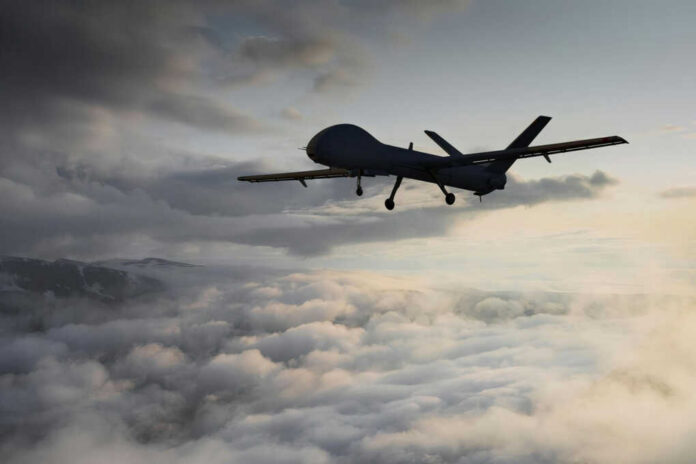
The Pentagon’s fiscal year 2027 budget request reveals a staggering $54.6 billion allocation for a newly expanded Defense Autonomous Warfare Group, signaling a fundamental shift in how America prepares for modern warfare while raising questions about whether taxpayers are funding another bureaucratic monster or genuine national security.
Story Highlights
- Pentagon requests unprecedented $54.6 billion for Defense Autonomous Warfare Group in FY2027, representing a massive budget surge from previous funding levels
- Ukraine conflict exposes critical U.S. shortfall in low-cost drone capabilities as adversaries deploy millions of cheap drones annually
- Defense Secretary Pete Hegseth accelerates American drone production, targeting 300,000+ units in 18 months to end reliance on foreign suppliers
- Twenty-five U.S. companies compete in rapid acquisition programs, with contracts awarded in as little as 72 hours versus traditional years-long procurement cycles
Massive Budget Increase Targets Drone Warfare Gap
The Pentagon’s FY2027 budget proposal seeks $54.6 billion for the Defense Autonomous Warfare Group, marking an extraordinary expansion of autonomous drone capabilities. This dramatic funding increase reflects urgent lessons from the Ukraine conflict, where inexpensive drone swarms have fundamentally altered modern combat. The request represents a stark departure from traditional defense spending patterns, channeling resources toward AI-driven autonomous systems capable of operating across land, sea, and air domains. Defense officials justify the surge by pointing to adversaries producing millions of cheap drones yearly while America struggled with inadequate low-cost, expendable systems.
Ukraine War Exposes Critical American Vulnerabilities
Combat operations in Ukraine revealed a troubling reality: cheap drone swarms caused most battlefield casualties while exposing severe U.S. shortfalls in comparable capabilities. Adversaries fielded over one million drones yearly, creating swarms that overwhelmed traditional defenses at minimal cost. This asymmetric advantage forced Pentagon strategists to confront an uncomfortable truth about America’s technological superiority. The conflict demonstrated that expensive, sophisticated weapons systems prove less effective against mass-produced, expendable drones costing mere thousands of dollars. Defense Secretary Pete Hegseth called drones “the biggest innovation in a generation,” acknowledging the fundamental shift in modern warfare dynamics that traditional Pentagon bureaucracy failed to anticipate.
Hegseth Accelerates American Drone Production
Defense Secretary Hegseth issued a July 2025 memorandum rescinding production restrictions that had hampered domestic drone manufacturing, prioritizing American-made systems over foreign alternatives. The Pentagon banned non-U.S. drones from government stocks, seeking to create an “American DJI” that would eliminate dependence on Chinese components. This America First approach aims to leverage private capital while building a sustainable domestic industrial base. The Drone Dominance Program targets 30,000 units at $5,000 each, with acquisition cycles compressed to months instead of years. Army officials completed some contracts in 72 hours, demonstrating unprecedented procurement speed that bypasses traditional bureaucratic obstacles.
Rapid Competition Selects Top American Manufacturers
The February 2026 Drone Dominance Gauntlet at Fort Benning, Georgia, selected 11 leading companies for $150 million in prototype funding after warfighter-led evaluations. Companies including Skydio, AeroVironment, Skycutter, Kratos, and Halo competed for contracts in compressed timelines that favor agility over established defense contractors. The Army awarded $52 million to Skydio and $117 million to AeroVironment in March 2026, with systems expected to deploy within months. Pentagon officials now review 90-plus unmanned aerial systems through a dedicated portal, providing what Deputy Assistant Secretary James Mismash calls “stable demand signals” that encourage commercial vendors to invest. A second competition scheduled for August 2026 targets 100,000-plus one-way attack drones by 2027.
Persian Gulf Tensions Drive Emergency Counter-Drone Spending
Ongoing Persian Gulf operations under Operation Epic Fury exposed another critical vulnerability as American forces depleted $350 million in interceptors within 30 days combating Iranian drone swarms. The Pentagon responded with $600 million in emergency counter-drone procurements, buying time while new defensive systems reach the field. The Counter-Drone Task Force requested $580.3 million for research and development in FY2027, a massive increase from the prior year’s $6.5 million allocation. This reactive spending pattern raises legitimate questions about whether defense planners adequately anticipated drone threats or simply failed to act until crises forced their hand, wasting taxpayer resources on emergency measures.
Billions Flow to Defense Contractors Amid Uncertain Outcomes
The $54.6 billion DAWG expansion funnels unprecedented resources toward autonomous warfare capabilities, creating obvious winners among defense contractors while taxpayers shoulder enormous costs. Advocates argue this investment matches adversary production scales and secures American technological superiority in AI-driven swarm operations. Critics might reasonably question whether this represents sound strategic planning or another Pentagon spending spree that enriches contractors without delivering battlefield results. The Replicator initiative already missed its August 2025 goals, highlighting integration challenges in commanding autonomous swarms despite earlier funding commitments. Whether this massive budget surge produces genuine capability or merely feeds the defense-industrial complex remains unclear, leaving Americans to wonder if their government learned from past failures or simply doubled down on the same broken procurement processes that created vulnerabilities in the first place.
Sources:
Pentagon Touts Momentum in Push to Bolster US Drone Industry – Aviation Week
Pentagon’s Counter-Drone Task Force Seeks More Than $580 Million for R&D in 2027 – Defense Daily
Pentagon to Increase Low-Cost Drone Production in US – War.gov
Pentagon Leans Into Drone Swarms with $100M Challenge – Defense One
Pentagon Taps 25 Firms for Small, Cheap Attack Drone Competition – Army Times
Pentagon to Procure $600M Worth Counter Drone Systems – Defense Mirror