
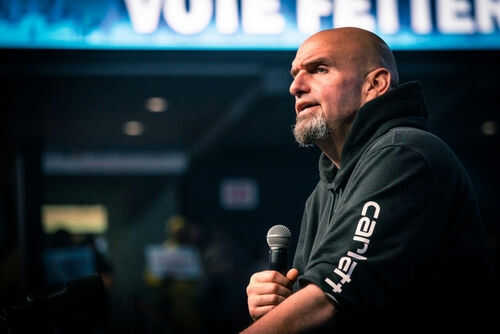
A sitting Democratic senator just admitted what conservatives have been saying for years: the Democratic Party has no real leader and is instead controlled by an irrational obsession with opposing Trump at all costs.
Story Snapshot
- Pennsylvania Sen. John Fetterman declared “Trump Derangement Syndrome” governs the Democratic Party during a podcast appearance in March 2026
- Fetterman argued Democrats face party backlash for agreeing with Trump on any issue, even hypothetical endorsements of “ice cream and lazy Sundays”
- The senator’s critique comes amid a Democratic leadership vacuum following 2024 election losses and highlights growing internal party divisions
- Fetterman’s maverick stance distances him from progressive Democrats on issues including Israel aid and Iran policy, risking primary challenges
Democratic Senator Breaks Party Ranks on TDS Obsession
Pennsylvania Democratic Sen. John Fetterman stated on the “All-In Podcast” in March 2026 that the Democratic Party lacks formal leadership and is instead “governed by” Trump Derangement Syndrome. The term, popularized by Trump supporters to describe irrational opposition to the former president, came directly from Fetterman’s mouth as he criticized his own party’s inability to find common ground with Trump on any issue. When podcast hosts asked who leads the Democratic Party, Fetterman’s answer was blunt: TDS itself has become the driving force behind Democratic decision-making and messaging.
Fetterman illustrated his point with striking examples, noting Democrats would face backlash even if Trump endorsed something as innocuous as “ice cream and lazy Sundays.” This observation cuts to the heart of what many conservatives have witnessed for years—a reflexive opposition to anything Trump-related that prioritizes partisan hatred over common sense governance. The Pennsylvania senator argued this dynamic prevents Democrats from putting “country over party” on critical issues, including military operations and bipartisan national security matters. His willingness to use the term TDS, typically dismissed by Democrats as a right-wing talking point, signals a rare moment of internal party accountability.
Pattern of Intra-Party Criticism Emerges
Fetterman’s podcast remarks represent the latest in a growing pattern of intra-party criticism since his 2022 Senate victory. The senator has increasingly distanced himself from progressive Democrats, challenging party orthodoxy on Israel aid and Iran policy while condemning what he sees as reflexive anti-Trump positioning. In late March 2026, Fetterman also condemned Philadelphia protesters who cheered against U.S. service members, directly linking their rhetoric to the same Trump Derangement Syndrome controlling party leadership. His evolution toward moderate positions appears calculated to appeal to Pennsylvania’s swing-state voters ahead of his 2028 reelection campaign.
This shift carries significant risk for Fetterman within Democratic circles. Party activists and progressive donors typically punish dissent from anti-Trump orthodoxy, potentially triggering primary challenges from the left. Yet Fetterman seems willing to gamble that Pennsylvania voters—exhausted by partisan theatrics and eager for practical governance—will reward his independence. His critique also exposes a genuine leadership vacuum within the Democratic Party following 2024 election losses, with no clear successor to unify the party beyond opposition to Trump. This vacuum creates space for voices like Fetterman’s to challenge party direction without facing immediate consequences from established leadership.
Conservative Implications and Leadership Void
Fetterman’s admission validates what conservatives have long argued: Democrats often prioritize opposition to Trump over substantive policy positions or national interests. This obsession prevents bipartisan cooperation on issues where agreement should be straightforward, from military operations to basic governance questions. The senator’s reference to hypothetical bipartisan support for operations like those involving Iran demonstrates how TDS blocks Democrats from supporting necessary national security actions simply because Trump or his administration might be involved. For Americans frustrated with endless partisan gridlock and regime change wars, Fetterman’s critique highlights how ideological rigidity prevents practical solutions.
The broader implications extend beyond one senator’s podcast appearance. Fetterman’s willingness to publicly diagnose his party’s TDS problem signals potential cracks in Democratic unity heading into the 2026 midterms. Conservative outlets have amplified his remarks as evidence of Democratic dysfunction, while the party establishment has notably remained silent rather than rebut his claims. This silence suggests either tacit acknowledgment of the problem or uncertainty about how to respond without proving Fetterman’s point. For conservatives who value limited government and constitutional principles over partisan warfare, the revelation that a major political party is governed by derangement rather than principle underscores the importance of holding all politicians accountable to substance over reaction.
Sources:
Fetterman: Democrats have no leader, ‘Trump Derangement Syndrome’ instead – Fox News
Fetterman: ‘Trump Derangement Syndrome’ Controls Party – RealClearPennsylvania
Sen. Fetterman condemns hateful speech about US service members – KOMO News