NATO’s top diplomat is showering Trump with praise because Europe still wants U.S. protection on the cheap.
Story Snapshot
- NATO leaders now promise a massive 5% of GDP for defense by 2035, after years of underpaying.
- Secretary General Mark Rutte flatters Trump as “completely committed” while trying to calm his anger over NATO freeloaders.
- Trump’s pressure is credited with a huge jump in allied defense spending, but key promises remain political, not legally binding.
- Data gaps and mixed messages inside NATO raise real questions about whether Europe will truly carry its fair share.
Trump’s Tough Line Forces NATO to Pay Up
President Donald Trump’s hard push on defense spending has forced NATO allies to admit they spent too little for far too long and to pledge a huge increase going forward.[2] At the 2025 summit in The Hague, every member state agreed to aim for spending **5% of its economy** on defense and related security by 2035, a huge jump from the old 2% goal.[2] This new pledge only came after years of Trump warning that the United States would not carry Europe’s defense forever without real burden-sharing.
According to NATO’s own numbers, allies finally hit the old 2% benchmark in 2025, after missing it for more than a decade.[2] European countries and Canada raised their defense budgets by about 20% in a single year, and now spend roughly 2.3% of their combined economies on defense, more than 570 billion dollars in 2025 alone.[2][5] NATO officials openly credit Trump’s pressure campaign for this surge, and even friendly think tanks say the new 5% promise is the direct result of U.S. demands.[5]
Rutte Plays “Trump Whisperer” to Keep U.S. in the Alliance
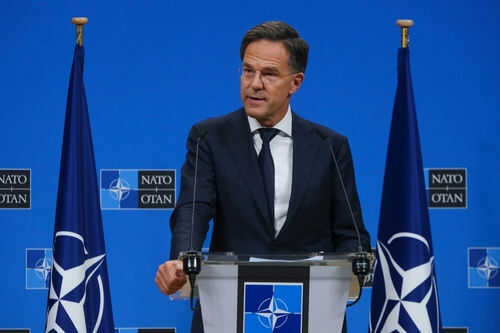
NATO Secretary General Mark Rutte came to the White House days before the next summit with one clear mission: keep Trump inside the alliance, and keep European defense guarantees intact.[4][8] Reporters describe Rutte as a “Trump whisperer” because he uses heavy flattery and calm language to cool Trump’s anger over what he calls European “free riders.”[4][8] Rutte told cameras that Trump is “completely committed” to NATO and insisted European allies have “been there” for the United States, even while the Pentagon reviews whether to shrink the U.S. troop presence in Europe.[4][8]
Rutte has a long political history with Trump and leans on it hard.[5] He goes on friendly media, like Fox News, to praise Trump’s Iran policy and back his effort to stop that regime from getting nuclear weapons.[8] He also privately texted Trump that Europe “is going to pay in a BIG way, as they should, and it will be your win,” language clearly meant to assure Trump that his tough stance is finally forcing Europe to take defense seriously.[3][8] For conservative Americans, the message is simple: Trump’s leverage is working, and NATO’s top official knows it.
Big Promises, Weak Teeth: Is the 5% Pledge Real?
Even with these bold numbers, NATO’s own history shows a pattern of big talk and weak follow-through when it comes to spending.[12] Past guidelines, like the 2% goal first set in 2006 and reaffirmed at the Wales summit in 2014, were treated as political promises rather than hard treaty rules, and many members ignored them for years.[12][13] Researchers who study NATO burden-sharing note that most countries adjust military budgets based on local politics and economics, not joint defense needs, leading to long periods where only a few members ever met the spending targets.[12]
Today’s 5% pledge fits that same pattern.[2][6] NATO documents call it a “commitment” and break it down into 3.5% for core defense and 1.5% for infrastructure, cyber defense, and industrial base, but they do not turn it into a binding legal condition for mutual defense.[2] That means the famous Article 5 promise—attack one, and you attack all—still does not formally depend on meeting any spending number. For constitutional conservatives who care about clear rules and limits, this gap between political talk and legal reality should raise warning flags about how solid Europe’s promises truly are.
Numbers Games and Hidden Interests Behind NATO Spending
Trump’s critics say his claims about specific countries, like calling Spain a “free ride,” lack public audit backing.[3] But at the same time, NATO officials themselves present mixed and sometimes conflicting data, especially on Germany’s future spending plans, which undermines trust.[3] Analysts point to a large jump in European defense budgets and note that one European ally even passed the United States in defense spending per person, yet they also admit that past pledges took many years to show up in real capabilities.[5][7]
𝐓𝐑𝐔𝐌𝐏 𝐀𝐓 𝐍𝐀𝐓𝐎 𝐒𝐔𝐌𝐌𝐈𝐓: 𝐈𝐓𝐀𝐋𝐘, 𝐔𝐊, 𝐆𝐄𝐑𝐌𝐀𝐍𝐘, 𝐅𝐑𝐀𝐍𝐂𝐄, 𝐀𝐍𝐃 𝐒𝐏𝐀𝐈𝐍 𝐀𝐁𝐀𝐍𝐃𝐎𝐍𝐄𝐃 𝐀𝐌𝐄𝐑𝐈𝐂𝐀 𝐃𝐔𝐑𝐈𝐍𝐆 𝐓𝐇𝐄 𝐈𝐑𝐀𝐍 𝐖𝐀𝐑
Standing directly beside NATO Secretary General Mark Rutte at Tuesday’s summit in The Hague, President… pic.twitter.com/NhoJlUrRGD
— M.A. Rothman (@MichaelARothman) June 24, 2026
Behind the scenes, there are money interests at work as well. Think tanks and defense trackers warn that higher NATO targets also mean more cash for big defense contractors across the Atlantic, who lobby for larger budgets and long-term arms deals.[6][16] If spending is driven more by industry pressure than by clear security needs, American taxpayers could be asked to support a system where Europe talks about “burden-sharing” while companies reap the profits and the legal obligations on our troops never change. That is exactly the kind of globalist, unaccountable setup many conservatives have opposed for years.
Sources:
[2] Web – Finance and economics annual statistical bulletin: international …
[3] Web – Defence expenditures and NATO’s 5% commitment
[4] Web – NATO Spending by Country 2026 – World Population Review
[5] Web – [PDF] Defence Expenditure of NATO Countries (2014-2025)
[6] Web – NATO defense spending tracker – Atlantic Council
[7] Web – NATO countries defense expenditure 2025 – Statista
[8] Web – In 2025, for the first time in NATO history, a European ally surpassed …
[12] Web – ‘Another big success’: Nato leader flatters Trump before The Hague …
[13] Web – NATO’s Rutte to meet Trump, aiming to ease tensions ahead of July …
[16] Web – A Critical Review of NATO Burden Sharing from 1949 to the Present