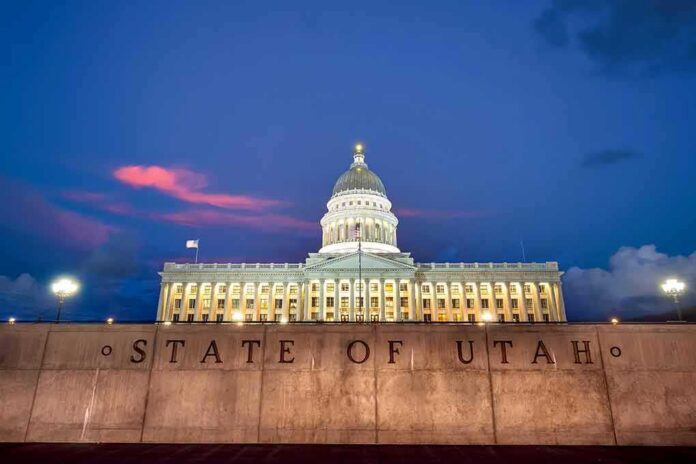
Utah just adopted a proof-of-citizenship voting system that limits nonverified voters to federal-only ballots, drawing a sharp line against noncitizen voting while keeping elections open to eligible citizens.
Story Highlights
- Utah’s new law requires documentary proof of citizenship for full ballots and creates a challenge process.
- Accepted documents include a Utah driver’s license or ID number, birth certificate, or passport.
- A White House summary cites strong public support for voter ID and proof of citizenship.
- Federal prosecutors charged 28 California green-card holders in alleged voting cases, while broader lists remain disputed.
Utah Sets Proof-of-Citizenship Standard With Federal-Only Ballots
Utah lawmakers passed H.B. 209, which builds a documentary citizenship framework and a process to review and challenge a registrant’s status. Voters who do not provide proof may vote only in federal races, while those who do receive full state and local access. The law gives election officers clear steps to determine eligibility. This structure aims to protect local control and integrity without taking the ballot away from verified citizens who follow the rules.
Utah’s statute lists several paths to prove citizenship. Voters can show a Utah driver’s-license number, a state identification-card number, a birth certificate, or a United States passport, among other routes. The design is practical: use common documents most people already have. The law also authorizes officials to check records and resolve questions. That helps prevent errors and keeps the rolls clean. It also gives citizens clarity on what they need well before Election Day.
Public Backs ID And Citizenship Checks Across Party Lines
A March White House release citing Gallup reported that large majorities support voter identification and proof of citizenship for registration. Reported support reached 84 percent for voter ID and 83 percent for proof of citizenship. Backing spanned parties, with strong levels among Republicans, independents, and even a majority of Democrats. Broad support matters because election rules work best when people across the spectrum see them as fair, simple, and focused on honest results.
Support for basic checks also reflects frustration with years of lax standards. Citizens watched inflation sap savings and saw federal systems bend to politics. They want competence and clear rules. Identification at the polls and proof of citizenship at registration are common sense steps that fit that demand. Utah’s approach tries to balance access with accountability. It offers a defined path for every eligible voter and a way to separate errors from abuse before ballots get counted.
Enforcement Cases In California Show Why Guardrails Matter
Federal prosecutors charged 28 lawful permanent residents in California for allegedly registering or voting in violation of rules that limit participation to citizens. These cases are not a statewide verdict, but they show real risk points. The Department of Justice also flagged about 20,000 records it described as likely noncitizens in litigation, giving investigators a dataset to check. Even if many entries prove eligible, the review exists because systems allowed questionable records to form in the first place.
Local sampling in Los Angeles County found many names on the federal list with no voting history, and a sizable share appeared to be United States-born citizens, highlighting data-matching flaws. That mix proves two things at once: enforcement is needed, and data must be accurate. Utah’s model responds on both fronts. It sets clear documents to confirm status and creates a challenge and cure path to fix mistakes. That reduces bad matches while keeping pressure against illegal voting.
What Utah’s Law Does—and Does Not—Claim
Utah’s statute does not allege past statewide fraud. It is a forward-looking safeguard that separates those who have documented citizenship from those who have not yet shown it. Critics point to studies and audits that find noncitizen voting rare and warn about access burdens. Some research cited in press reports also notes turnout gaps in places with strict identification rules, though findings are mixed across studies. Policymakers still must set rules that protect every ballot and every voter.
Clear documentation helps honest voters and honest officials. It stops shortcuts, limits confusion, and narrows room for error or abuse. It also supports confidence, which is vital after years of mistrust. President Trump’s administration has argued for stronger verification, while Utah’s legislature delivered a blueprint that other states can study. The next test is execution: fast processing, simple guidance, and tight audits that confirm eligible voters get full ballots and ineligible voting gets blocked.
Sources:
zerohedge.com, le.utah.gov, npr.org, whitehouse.gov, abcnews.com, kansas.com