A top Trump envoy is now being linked to a reported $5 billion fundraising push from foreign governments—exactly the kind of optics that can hand America’s enemies and the legacy media an easy talking point.
Quick Take
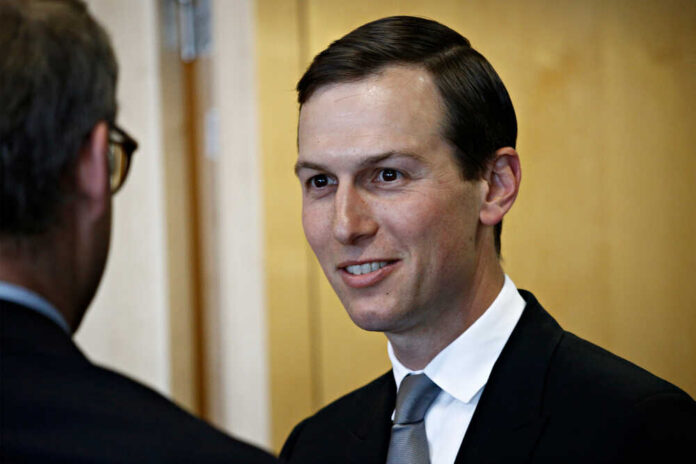
- Multiple outlets, citing New York Times reporting, say Jared Kushner is seeking at least $5 billion more for Affinity Partners from Middle East government-backed funds while serving as U.S. Special Envoy for Peace.
- The reported fundraising effort appears to contradict Kushner’s December 2024 public statement that $1.5 billion raised from Qatar/UAE-linked sources would cover his firm “for the next four years” to avoid conflicts.
- The same region tied to the fundraising is central to Kushner’s diplomatic portfolio, including high-stakes issues involving Iran and broader regional security.
- Kushner’s envoy role reportedly triggers financial disclosure expectations, with watchdogs pointing to a looming filing deadline and unresolved transparency questions.
What the report says Kushner is seeking—and from whom
Multiple reports echoing New York Times sourcing say Jared Kushner, now serving as President Trump’s U.S. Special Envoy for Peace, is pursuing at least $5 billion in new capital for his private equity firm, Affinity Partners, from Middle Eastern government-backed investors. The cited targets include Saudi Arabia’s Public Investment Fund, along with investors connected to Qatar and the United Arab Emirates. The New York Times story reportedly relied on five people familiar with the discussions.
The timeline described in the coverage places renewed outreach in early March 2026, including reported meetings between Affinity representatives and Saudi Arabia’s PIF. Other reports say Kushner made fundraising-related contacts around the same period with potential backers tied to Qatar and the UAE. As of the follow-up coverage cited in the research, no outlet confirmed a completed new investment—only that conversations and pitching were underway.
The December 2024 pledge that now drives the controversy
The ethical heat in this story is tied to a specific, public claim. In December 2024, Kushner discussed fundraising on the “Invest Like the Best” podcast and said Affinity had raised $1.5 billion “preemptively,” describing it as enough to cover the firm’s needs “for the next four years.” The reason given in the reporting was to avoid fundraising during Trump’s term and reduce potential conflicts of interest while he participated in public matters.
If the New York Times-sourced accounts are accurate, the new $5 billion push creates a straightforward credibility problem: it suggests a reversal from the earlier “we’re funded, no need to raise more” message that was supposed to keep distance between public influence and private fundraising. Even without proof of any policy trade, the practical issue is public trust—because sovereign wealth funds are arms of foreign governments, and an envoy’s perceived independence matters in sensitive negotiations.
Why the overlap matters in a peace-envoy role
The reporting emphasizes that Kushner is not simply a private businessman. President Trump appointed him Special Envoy for Peace on Feb. 19, 2026, formalizing a role connected to Middle East diplomacy. The broader context described in the sources includes heightened regional tensions and U.S. policy decisions involving Iran, alongside Saudi and Emirati interests. That overlap—diplomatic access on one hand, foreign-government fundraising on the other—is why watchdog groups frame the situation as a potential conflict.
Another structural concern raised in the coverage is oversight. The research notes Kushner’s envoy position does not involve Senate confirmation, which critics argue reduces routine scrutiny that comes with confirmed posts. At the same time, the reporting indicates that the envoy role triggers financial disclosure expectations, and ethics advocates have highlighted an upcoming deadline that could clarify what financial interests are in play. Until that disclosure is public, readers are left with claims and counterclaims rather than a complete record.
What is confirmed, what is still unproven, and what to watch next
The best-supported facts across the cited outlets are the sequence: Affinity Partners launched after Trump’s first term; Saudi Arabia’s PIF invested $2 billion early on; Kushner later described raising $1.5 billion in late 2024 to avoid conflicts; and, after his Feb. 2026 appointment, New York Times-sourced reports say he is seeking $5 billion or more from the same region. The biggest unknown is whether any new commitments have been finalized.
Jared Kushner Reportedly Seeks $5B From Middle East Governments for His Firm While Serving as Envoy https://t.co/XQiyl2G3tv
— Mediaite (@Mediaite) March 17, 2026
For conservatives who spent years watching bureaucrats and global NGOs operate with minimal accountability, the standard should stay simple and consistent: transparency, clean lines, and America-first decision-making that cannot be second-guessed as pay-to-play. The next concrete checkpoint is the expected financial disclosure and any documentation that clarifies whether active fundraising coincides with specific diplomatic actions. Until then, the story remains an ethics-and-oversight controversy built on reported meetings and sourcing rather than publicly released deal documents.
Sources:
Kushner Breaks Pledge, Seeks $5 Billion More From Foreign Governments
Jared Kushner Seeks $5 Billion From Foreign Governments for Private Firm
Jared Kushner Reportedly Seeks $5B From Middle East Governments for His Firm While Serving as Envoy