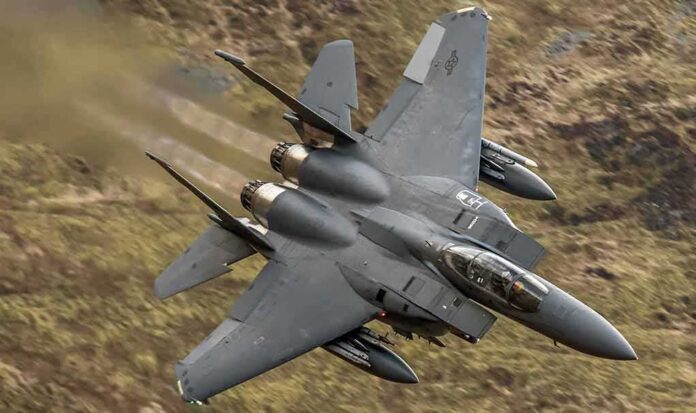
America’s new F-15EX Eagle II brings unmatched payload and 20,000-hour endurance to the fight, strengthening a mixed Air Force that pairs massed firepower with stealth where it counts.
Story Highlights
- The Air Force confirms F-15EX carries more weapons than the F-35, boosting combat mass.
- The F-15EX airframe is designed for a 20,000-hour service life, cutting replacement churn.
- Officials planned the F-15EX to replace aging F-15C/D jets that are timing out of service.
- Reports describe the F-15EX as a complement to F-35 and F-22 stealth aircraft, not a substitute.
What The Air Force Says The F-15EX Brings
The Congressional Research Service records the Air Force view clearly: the F-35 delivers stealth and sensor fusion, while the F-15 family brings more payload. That means the F-15EX can haul more missiles and standoff weapons on day two and day three of a fight. It can also escort and defend large areas at home. This is not guesswork or hype. It is the official division of labor the service uses to build a stronger, mixed fighter force.
Government Accountability Office reports say the F-15EX adds modern sensors, fly-by-wire controls, digital cockpit, and advanced electronic warfare, including the Eagle Passive Active Warning Survivability System for United States jets. Those upgrades matter. They let a proven airframe carry more, shoot more, and survive better against jamming and radar threats. The result is a high-capacity weapons truck that talks to stealth jets, shooters at sea, and ground forces when the mission needs mass.
Why The F-15EX Replaces Aging Eagles Now
The F-15C/D fleet is running out of time. In sworn testimony, Air Force acquisition chief Will Roper warned that 234 F-15C/D jets would hit the end of their service life within six to eight years, and extending them was not cost-effective. The F-15EX was designed to step in fast, using a live production line backed by more than $2 billion in foreign investment to keep parts and skills warm. This protects readiness while the nation fields next-generation stealth and air dominance programs.
The Government Accountability Office confirms the core plan: replace worn F-15C/Ds with F-15EX and operate it alongside the F-35 and F-22. That lets commanders send stealth first to break defenses, then surge F-15EX for air defense, missile hauling, and homeland missions. It is a common-sense mix that spreads risk, saves schedule, and keeps pilots in jets that work today. For taxpayers, it also preserves an industrial base that can deliver at speed.
Durability, Availability, And The 20,000-Hour Design
The F-15EX airframe is built for 20,000 flight hours, far beyond many legacy fighters. That long life can lower fleet churn and training disruption. Units can keep aircraft on the ramp and pilots in the air instead of rotating through depot lines. The design aims to cut total downtime across decades. In plain terms, a jet that flies longer between major replacements helps the force stay ready while Congress and the Pentagon balance budgets and threats.
The Government Accountability Office also highlights how the F-15EX adds modern reliability with new wiring, computing, and controls. That can help maintainers fix issues faster and get jets back in the fight. Faster turnaround means more sorties when it counts. In a Pacific scenario, where long ranges and quick reloads decide outcomes, the ability to launch again and again with a heavy missile load is a decisive edge for American airpower.
What The F-15EX Is Not, And Why That Is Fine
The F-15EX is not a stealth jet, and official reporting does not rate it as superior overall to the F-35. The Air Force frames the jets as complementary: F-35 for stealth penetration and sensor fusion, F-15EX for payload and capacity. Some commentary argues non-stealth aircraft risk more in dense air defenses, but that claim echoes the same complementary logic that leaders already use. Missions differ. Tools should match the job, not a one-size-fits-all ideal.
Program size has shifted over budget cycles, moving from early talk of 144 jets to lower figures in some requests, which shows normal force-structure tradeoffs rather than failure. Congress and the Pentagon adjust numbers to meet threats, funding, and delivery schedules. Through those shifts, the record still shows a clear need: replace aging F-15C/Ds now, keep production lines healthy, and field a team where stealth breaks doors and F-15EX brings the muscle to finish the job.
Sources:
19fortyfive.com, gao.gov, congress.gov