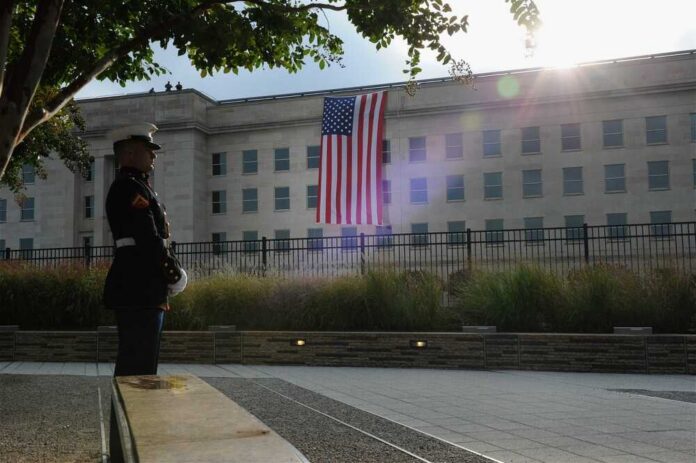
Washington just swapped the Army’s top uniformed leader in the middle of a shooting war with Iran—fueling fresh doubts among MAGA voters about whether “no new wars” has quietly become another Washington slogan.
Story Snapshot
- Defense Secretary Pete Hegseth asked Army Chief of Staff Gen. Randy George to step down effective immediately as U.S. operations against Iran continue.
- Reports vary on wording—“asked to step down” versus “fired”—but multiple outlets say the removal followed clashes over promotions and broader Pentagon direction.
- Gen. Christopher Lee was named acting Army chief, creating a fast leadership transition during active operations.
- The shake-up follows other recent senior-leader removals, raising concerns inside the ranks about stability and trust in the promotion system.
Army leadership changed mid-conflict as Pentagon confirms George’s departure
Pentagon leadership confirmed that Defense Secretary Pete Hegseth requested Army Chief of Staff Gen. Randy George step down effective immediately, a rare move while U.S. forces are engaged in ongoing military operations against Iran. Some reporting described the decision as an ouster or firing, while the Pentagon language emphasized a resignation request. The Joint Chiefs publicly thanked George for his service dating back to 1988 as the transition began.
Gen. Christopher Lee was appointed acting Army chief, creating an abrupt handoff at the top of the service. Public explanations have been limited, and some coverage said officials did not tie the decision to a single incident. The timing matters: changing senior uniformed leadership during active operations can disrupt decision cycles, messaging to commanders, and confidence in continuity—especially when troops and families are already watching escalation risks and energy-market ripple effects at home.
Promotion disputes and “merit vs. politics” arguments collide inside the Pentagon
Several reports linked the break between Hegseth and George to disagreements over promotions, including a dispute involving four general-officer promotions described in coverage as including two African-American officers and two female officers. Other reporting said Hegseth had been blocking promotions more broadly across the services. Without a detailed official rationale, the strongest verified point is the existence of internal friction over personnel decisions and Pentagon direction rather than operational failures on the battlefield.
For conservative readers, the frustration is less about cable-news narratives and more about basic governance: the military needs a promotion system trusted by the force and a leadership structure insulated from fashionable political tests. Critics warn that perceived politicization—whether framed as enforcing ideology or “purging” dissent—can corrode morale and faith in fairness. Supporters of tougher civilian control argue elected leadership should be able to redirect the Pentagon when priorities shift during war.
A pattern of senior removals raises questions about readiness and accountability
Reporting around George’s removal described it as part of a broader pattern of recent dismissals or forced exits involving other senior Army leaders. That context matters because one leadership swap can be explained as a normal change of command, but repeated churn at the top tends to signal deeper conflict over strategy, culture, or bureaucratic resistance. The Pentagon has not released a comprehensive explanation tying these moves together, leaving the public to interpret a patchwork of leaks and statements.
Accountability in a constitutional system cuts both ways: civilian leaders must oversee the military, but they also owe the country transparency when drastic changes occur during wartime. When official messaging is thin, Americans fill the gap with worst-case assumptions. That dynamic is especially combustible right now as many Trump voters—already scarred by Iraq and Afghanistan—are split over involvement in Iran, increasingly skeptical of open-ended commitments, and wary of any drift toward regime-change logic.
MAGA divisions deepen as “America First” meets the reality of an Iran war
The administration’s internal Pentagon shake-up lands in the middle of a broader political problem: a large share of the Trump coalition backed him to secure the border, restore energy dominance, and avoid new foreign entanglements. With the U.S. engaged militarily against Iran, some supporters are asking what the strategic end state is, how long it lasts, and what Congress is being told. Those questions intensify when senior commanders are removed without detailed public justification.
The immediate constitutional concern for many conservatives is process and clarity, not personalities. Congress holds the power to declare war, and Americans expect serious oversight when the country is pulled toward deeper conflict. The more wartime decisions appear driven by internal power struggles, the harder it becomes to keep public trust—especially among voters who believe Washington has repeatedly sold wars with shifting rationales, then stuck taxpayers and military families with the bill while priorities at home went neglected.
Sources:
Pentagon chief Pete Hegseth removes top uniformed officer from Army as US wages war in Iran
Pete Hegseth asks Army chief of staff Randy George to step down
Hegseth asks the Army’s top uniformed officer to step down