
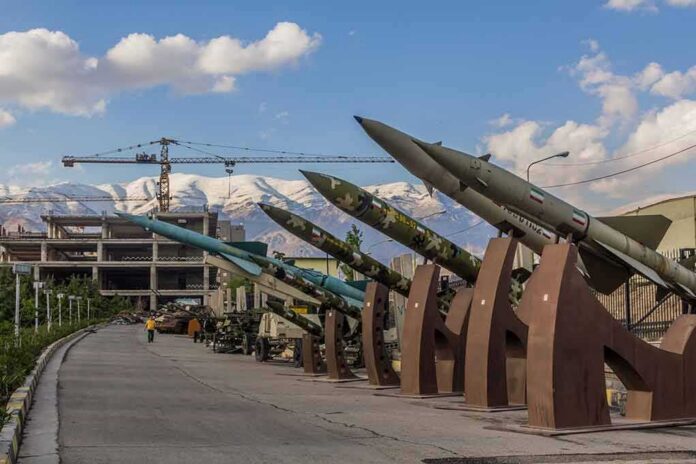
Fresh satellite images show Iran repairing key missile sites within weeks, raising urgent questions about how fast Tehran can reload its arsenal.
Story Highlights
- Satellite images show roads, tunnel entrances, and buildings at Iranian missile sites repaired within weeks.
- Israeli officials reportedly say Iran’s recovery is faster than expected.
- Reports and assessments point to several missile sites back near operational status.
- Estimates of monthly missile output vary widely, showing real uncertainty.
Satellite Evidence Points to Rapid Repair at Missile Hubs
Wall Street Journal reporting, summarized by Iran International and Times of Israel, says satellite images show Iran rapidly fixing damage at missile bases near Kangavar, Kermanshah, and Dezful. The imagery indicates restored roads, reopened tunnel entrances, and active reconstruction at a missile-component facility near Tehran. These repairs appeared within weeks of strikes, suggesting preplanned redundancy and strong logistics. Such visible work does not prove full production. But it does show the physical plant is coming back online faster than many expected.
Additional reporting points to visible activity at hardened sites like Parchin. Analysts reviewing commercial imagery described roof work, cleared debris, and renewed movement at Taleghan 2, a site tied to missile development. These signs match a pattern Iran has used for years: disperse, dig underground, and repair fast when hit. Again, on-the-ground inspections are lacking. Still, the consistent visual record across multiple locations supports the case for a brisk physical rebuild of the known network.
Operational Status and Output: What We Know and What We Don’t
Several open-source assessments say multiple missile plants and ranges returned to near-operational status by early 2026. One roundup cited at least a dozen such sites, including Parchin and Shahroud. This aligns with the intent of Iran’s military industry to absorb strikes and keep core lines ready. That said, imagery of repairs cannot confirm propellant, guidance electronics, and warhead integration are fully restored. Those supply chains are complex and hidden from public view.
Production-rate claims are inconsistent across sources. The Israel Defense Forces said in March that Iran was making “dozens” of projectiles per month and trending upward. A Congressional Research Service report quoted United States officials saying output was “over 100” per month. Other reports estimate 100 to 300 per month and forecast a return to prewar levels by 2027. The spread shows real uncertainty. It warns readers to treat any single number with care until more primary data is shared.
Counterpoints: Launchers Lost, Capacity Still in Question
Some analysts caution against reading too much into satellite photos of busy roofs and fresh pavement. Alexander Grinberg argued that visible rebuilding does not prove restored production rates. Others say launcher losses, not just factory damage, limit Iran’s near-term punch. The Jerusalem Post reported Israel Defense Forces claims that about 70 percent of mobile launchers were destroyed or neutralized. If true, Iran must fix both production and deployment to fully recover.
Further analysis from the Washington Institute said Israel hit Iran’s solid-propellant production in an October 26 strike, slowing quick restocking. A Le Monde review, citing the New York Times, added that while Iran repaired missiles and reopened most underground storage, that alone does not prove prewar capability. These counterpoints matter. They remind us that inventory, factory throughput, launcher availability, and logistics all decide real combat power, not concrete pours alone.
What This Means for U.S. Security and Policy Under President Trump
President Trump faces a determined rival that hides, disperses, and rebuilds under pressure. The evidence supports a clear takeaway: Iran’s missile ecosystem is resilient. It can fix what we can see, and it may be restoring what we cannot yet see. That threatens U.S. forces, allies, shipping lanes, and our homeland defenses if range and accuracy improve. America must protect its deterrent edge while refusing any deal that trades away verification or leaves underground capacity unchecked.
For conservatives who want peace through strength, the path is plain. First, expand missile defense and harden bases now. Second, tighten sanctions on propellant precursors, guidance chips, and specialty alloys—then show seizures to prove impact. Third, push declassification of methods behind production estimates so Congress and the public can see the truth. Finally, keep allies aligned on interdictions at sea and in the air. Transparency, pressure, and readiness beat wishful thinking every time.
Sources:
realcleardefense.com, firstpost.com, iranintl.com, timesofisrael.com, cnn.com, nypost.com, en.royanews.tv, everycrsreport.com