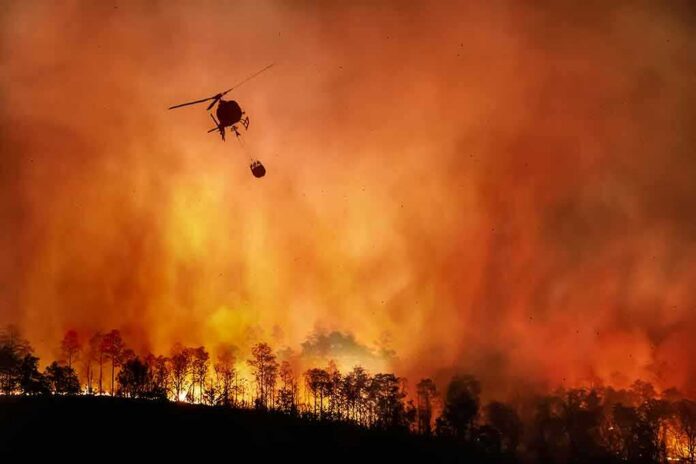
A deadly mid-air crash of two firefighting helicopters over Greece’s wildfire zone is a stark warning of how fast disaster can strike when crisis management and air safety are stretched to the limit.
Story Snapshot
- Two leased Bell helicopters collided while fighting a major wildfire west of Athens, killing two crew members.
- A Danish pilot and a Greek firefighting coordinator died, while a British pilot and another Greek coordinator survived.
- The crash happened over the Psatha coastal area amid a wider European wildfire and heatwave emergency.
- Greek authorities launched a search and rescue mission and opened an investigation into what caused the collision.
Mid-Air Collision Over Wildfire Front
Greek authorities say two firefighting helicopters collided in mid-air on a Sunday afternoon as they worked a large wildfire in western Attica, near the coastal area of Psatha. Both aircraft were **Bell helicopters** rented to support the wildfire fight and each carried two crew members. Video from about 40 to 45 miles northwest of Athens shows one helicopter striking the rotors of the other, which then bursts into flames and falls into a ravine. The second aircraft manages an emergency landing after the impact.
The national Fire Service of Greece reports that the collision occurred during aerial water-dropping operations over a fast-moving forest fire. Officials say the blaze had already destroyed more than 100 homes in the wider region and was being pushed by strong winds, adding pressure on crews in the air and on the ground. The crash took place as multiple fires burned across Attica and Boeotia, part of a broader European wildfire crisis linked to intense heat and dry conditions. That wider emergency helped explain why so many aircraft were in the sky at once.
Who Was On Board And What We Know About The Victims
Greek officials confirm that **two crew members were killed and two survived** the collision. Fire Service spokesperson Vassilis Vathrakogiannis identified the dead as a Danish pilot and a Greek firefighting coordinator, both working on the same helicopter that crashed in flames near Psatha. The survivors are a British pilot and another Greek coordinator on the second helicopter, who were recovered alive, with at least one reported injured and taken to hospital for treatment. Earlier reports mention all four as seasoned firefighting personnel brought in to reinforce Greece’s stretched disaster response.
Some early live coverage gave slightly different descriptions of nationalities and roles as reporters tried to sort facts in real time, but later official briefings lined up on this crew list and casualty count. Authorities say the helicopters had taken off from Elefsina military airport and were operating under the Fire Service’s command when they collided. The presence of foreign pilots alongside Greek coordinators reflects a growing trend: European countries now share aircraft and crews as cross-border wildfires become more common and more severe year after year. That cooperation can save lives, but it also demands very tight coordination.
Search, Rescue, And An Ongoing Investigation
Right after the crash, Greece’s Fire Service and other emergency teams launched a **search and rescue operation** in the Psatha area. Officials say one helicopter’s crew was found and reported safe first, while rescuers continued to search rough terrain to reach the second aircraft and assess its crew. Once they confirmed two deaths and two survivors, authorities moved the injured to hospital and began securing the crash sites for investigators. The incident added strain to a firefighting system already working around the clock on multiple fronts.
A shocking mid-air collision occurred near Psatha during a water-dropping operation to contain a fast-moving wildfire in western Attica, which has already destroyed over 100 homes. A dramatic video captured the moment the lower helicopter's main rotor struck the underside of the… pic.twitter.com/j4uGG7VqXM
— Pune Mirror (@ThePuneMirror) August 3, 2026
Greek authorities state clearly that the **exact cause of the collision remains under investigation**. Investigators are expected to review flight paths, radio communications, and maintenance records for both Bell helicopters to see whether pilot error, visibility problems from smoke, wind shifts, or coordination issues played a role. Video clips showing one rotor strike and a fireball help confirm the moment of impact but do not, by themselves, answer deeper questions about procedures and airspace control. For now, officials and reporters agree on the basic facts of the crash and the death toll, while the technical “why” is still an open question.
Sources:
youtube.com, bbc.com, cnbc.com, bbc.co.uk, abcnews.com, english.news.cn, nzherald.co.nz, instagram.com