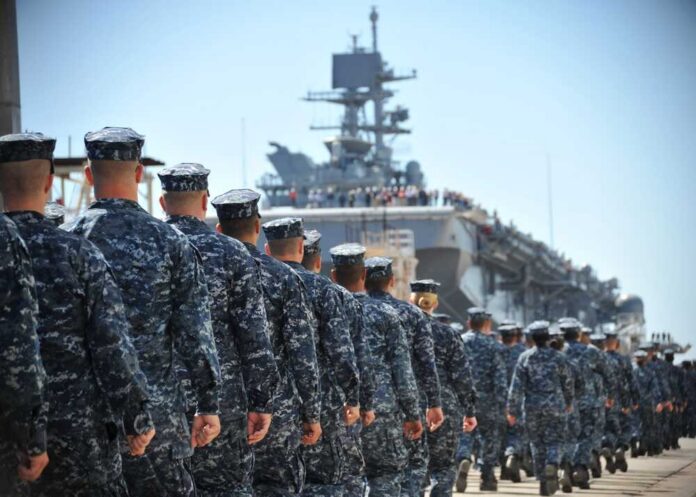
The U.S. military stands ready to seize Iranian-linked oil tankers and commercial vessels in international waters within days, marking one of the most aggressive naval operations against Tehran in decades.
Story Snapshot
- U.S. Marine Corps preparing imminent maritime raids to board Iran-linked ships in the Strait of Hormuz
- Operations target vessels suspected of carrying illicit oil or weapons through the world’s most critical oil chokepoint
- Move could disrupt 20% of global oil supply and trigger immediate Iranian retaliation
- Anonymous U.S. officials confirm readiness but no formal Pentagon announcement issued
A Naval Showdown in the World’s Most Dangerous Waters
The Wall Street Journal broke the story on April 18, 2026, citing unnamed U.S. officials who confirmed military preparations to intercept and board commercial tankers suspected of links to Iran. The operations focus specifically on the Strait of Hormuz, where approximately one-fifth of the world’s oil passes through a narrow waterway barely 21 miles wide at its chokepoint. Unlike routine freedom-of-navigation patrols, these planned actions involve actual seizures of vessels, not just monitoring. The Marine Corps will lead the maritime raids, bringing a level of tactical aggression not seen since the 1980s Tanker War during the Iran-Iraq conflict.
The timing reveals calculated escalation. Iran has long operated a shadow fleet of so-called ghost tankers that evade international sanctions by transporting oil to buyers willing to skirt U.S. restrictions. These vessels often disable tracking systems, transfer cargo ship-to-ship in international waters, and use shell companies to obscure ownership. The U.S. strategy targets this evasion network directly, aiming to strangle Tehran’s financial lifeline while the regime funds proxy militias across the Middle East. Previous tanker incidents in 2019 saw Iran seize British-flagged vessels in retaliation for U.K. actions, establishing a dangerous precedent for tit-for-tat maritime confrontations.
Economic Shockwaves Beyond the Persian Gulf
Oil markets face immediate volatility if boardings commence. Energy analysts understand that even the threat of disruption in the Strait of Hormuz sends prices climbing, and actual seizures accompanied by potential Iranian countermeasures could trigger supply panic. Shipping insurance rates will spike for any vessel transiting the region, forcing companies to either pay premiums or reroute around Africa, adding weeks and substantial costs to deliveries. Global consumers already grappling with inflation will feel the pinch at gas pumps and in heating bills as refineries adjust to uncertainty.
Gulf state allies face a delicate position. Saudi Arabia, the United Arab Emirates, and others depend on Strait of Hormuz access for their own oil exports while maintaining complex relationships with both Washington and Tehran. A U.S.-Iran clash in their backyard threatens regional stability and could draw them into unwanted hostilities. Meanwhile, China and India, major importers of Iranian oil despite sanctions, must recalculate their energy security strategies. The shipping industry itself confronts operational chaos as captains and companies weigh the legal and physical risks of transiting waters where military confrontation looms.
The Shadow War Surfaces
This operation represents the visible tip of a largely hidden conflict. For years, the U.S. and Iran have engaged in cyber attacks, proxy battles, covert sabotage, and intelligence operations that rarely make headlines. Boarding tankers in international waters brings that shadow war into daylight, forcing both nations to either escalate further or back down publicly. Iran’s Revolutionary Guard Corps controls many of the targeted vessels and views the Strait of Hormuz as strategic territory despite international law designating it as international waters. Tehran has repeatedly threatened to close the strait during past tensions, though never fully executing that threat due to its own economic dependence on the waterway.
U.S. MILITARY PREPARES TO BOARD IRAN-LINKED SHIPS IN COMING DAYS, OFFICIALS SAY- WSJ
— CGTN America (@cgtnamerica) April 18, 2026
The lack of official Pentagon confirmation raises questions about operational security and political calculation. Anonymous officials leaking to major news outlets suggests either authorized messaging designed to deter Iran or internal debate about the wisdom of such aggressive action. Either way, the U.S. military possesses overwhelming naval superiority in the region, with carrier strike groups, destroyers equipped with advanced missile systems, and Marine expeditionary units trained precisely for these boarding operations. Iran’s asymmetric capabilities include fast attack boats, anti-ship missiles, and naval mines that could inflict damage even against superior forces, making any confrontation unpredictable and dangerous despite the power imbalance.
Sources:
US Iran Blockade Oil Weapons Strait Hormuz Marine Corps Maritime Raids – Fortune
US Readying to Start Boarding Iran-Linked Ships in the Coming Days – Times of Israel