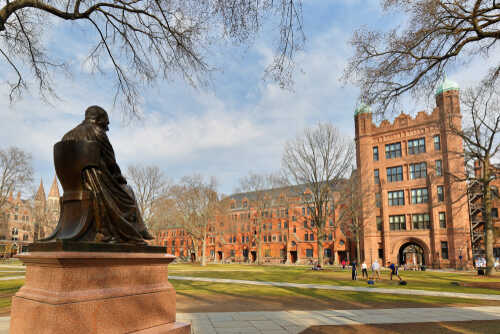
Yale University admits self-censorship and political bias are crushing public trust in elite higher education, validating decades of conservative warnings amid Trump administration funding pressures.
Story Highlights
- Yale faculty committee releases unanimous report pinpointing self-censorship, left-leaning bias, soaring costs, and free speech curbs as trust killers.
- Internal surveys reveal self-censorship among undergraduates doubled from 17% in 2015 to nearly 33% in 2025.
- President Maurie McInnis fully endorses 20 reforms, including free speech protections, amid federal grant freezes on rivals like Harvard.
- Report echoes historical critiques like Buckley’s 1951 exposé, urging accountability over elite deflection.
Report Details and Key Findings
Yale President Maurie McInnis convened the faculty-led Committee on Trust in Higher Education, which submitted its report on April 10, 2026, and publicly released it on April 15. The document diagnoses eroding public confidence through self-censorship, political bias, runaway tuition costs, opaque admissions processes, and restrictions on free expression. Internal Yale surveys from 2025 show nearly one-third of undergraduates now disagree they can freely express political beliefs on campus, up sharply from 17% in 2015. The committee’s unanimous analysis marks a rare Ivy League self-critique.
Historical Context and Rising Distrust
Public skepticism toward higher education traces to William F. Buckley’s 1951 book God and Man at Yale, which exposed left-leaning faculty bias. Modern triggers include post-2010s speech controversies, grade inflation, and tuition surges. Yale’s own 1974 Woodward Report enshrined free speech as essential, yet recent surveys confirm ideological conformity and administrative bloat. Broader polls indicate Republicans’ trust in neutral campus teaching below 20%. The new report benchmarks Yale against peers, highlighting mission creep in balancing selectivity with equity.
Stakeholders and Federal Pressures
President McInnis accepted all findings, committing deans to student forums on classroom openness and free speech education. The Trump administration’s actions—freezing $2.2 billion in Harvard grants and probing $8.7 billion more—intensify scrutiny on Ivy League funding tied to activism. Faculty divisions persist: sciences remain apolitical, while humanities defend against indoctrination charges. Conservatives and alumni demand anti-bias measures; the committee urges pluralism to combat echo chambers without curbing academic freedom. Yale’s Political Union stands as a pro-diversity exception.
Implementation and Broader Impacts
McInnis stated, “We must acknowledge how we have fallen short… Trust must always be earned,” tasking leaders with admissions transparency, budget reviews, and anti-administrative bloat initiatives. Short-term shifts may revive Woodward principles; long-term, Yale models elite self-reform but risks politicization. Students face chilled speech, postdocs fear retaliation, and public distrust drives enrollment drops. Economically, federal grants hang in balance; politically, it amplifies calls for oversight, aligning with frustrations over elite institutions prioritizing power over merit and open discourse.
Sources:
Report of the Committee on Trust in Higher Education
Yale committee report problems higher education Ivy League schools – Fortune
Report of the Committee on Trust in Higher Education – Yale President
Higher ed has a trust problem Yale thinks it has solutions – Chronicle