
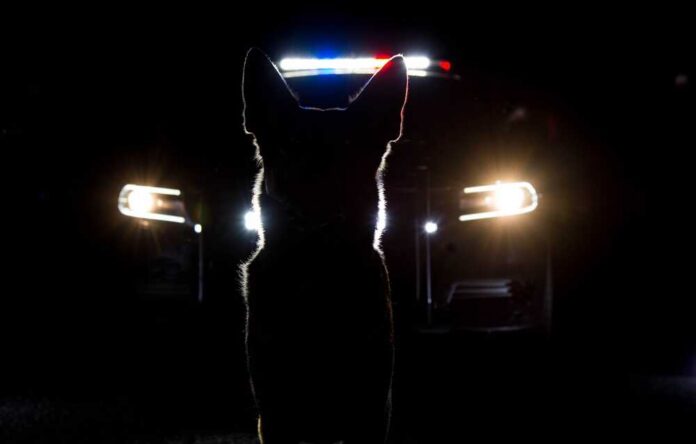
A heroic police K9 succeeded where human searchers and high-tech efforts failed, rapidly locating two lost children deep in a dense Indiana forest and reminding Americans of the unmatched reliability of traditional law enforcement tools.
Story Highlights
- Deputy Cody Loncaric and K9 Knox tracked 550 yards through thick terrain after multi-agency ground searches yielded nothing.
- Two 11-year-olds separated from their mother in a rural national forest; K9 Knox pointed first responders to their location deep in the woods.
- Incident underscores K9 units’ precision in challenging environments, building public trust amid frustrations with government inefficiencies.
- Similar rescues by K9 Hoot in Florida highlight ongoing value of trained dogs over drones or helicopters in missing child cases.
Brown County K9 Rescue Details
Two 11-year-olds separated from their mother while in a rural Indiana national forest. Initial searches by Brown County Sheriff’s Office, Indiana Department of Natural Resources Law Enforcement, Nashville Police Department, and fire departments found no trace. Deputy Cody Loncaric arrived with K9 Knox, a trained scent detection dog. Knox tracked a 550-yard scent line from a field into dense forest terrain. The dog alerted first responders, leading directly to the children safe and unharmed. The Sheriff’s Office credited inter-agency teamwork and Knox’s instincts for the successful outcome. Families expressed profound relief, calling the effort a blessing amid rising concerns over child safety in remote areas.
Historical Role of Police K9 Units
Police K9 programs originated in early 20th-century U.S. law enforcement, expanding significantly after World War II. Modern units train dogs like bloodhounds and dual-purpose breeds for scent detection in missing persons cases. These animals excel in trailing through urban alleys, streets, or thick woods where technology falters. The Brown County case mirrors patterns in rural woodland searches, where human efforts often fail initially. K9s provide rapid, precise results, reinforcing their place in public safety operations. This reliability contrasts with bureaucratic delays that frustrate citizens on both sides of the political aisle, who demand effective protection for vulnerable families.
Comparable K9 Successes Nationwide
In Port St. Lucie, Florida, K9 Hoot located four missing children over two years, including a 13-year-old autistic boy after tracking through urban areas just after nightfall. Handlers noted Hoot’s ability to pull officers through challenging paths, providing comfort to the child post-rescue. These incidents differ from rare stray dog aids, like a Louisville case where an unidentified dog led officers to a trapped 3-year-old in a backyard SUV. Trained K9s offer consistent performance, succeeding where initial multi-agency responses stall. Such stories highlight instinct-driven tools succeeding against odds.
Uncertainties persist on exact timelines and Louisville dog origins, yet verified bodycam footage confirms the heroics. These cases elevate K9 programs amid debates over funding priorities.
Broader Implications for Public Trust
Rescues like these deliver immediate family reunions and boost confidence in local law enforcement. Agencies gain reputational strength, potentially securing more resources for K9 training in rural searches. Socially, the events expose child safety risks in wooded or fringe areas, urging parental vigilance. While no economic or political data emerges, the outcomes affirm limited-government principles: frontline deputies and their canine partners deliver results without expansive federal overreach. Both conservatives valuing America First protections and liberals seeking welfare for the vulnerable appreciate these non-elite successes that bypass deep state inefficiencies.
Sources:
ABC News: Police dog finds 2 missing 11-year-olds