
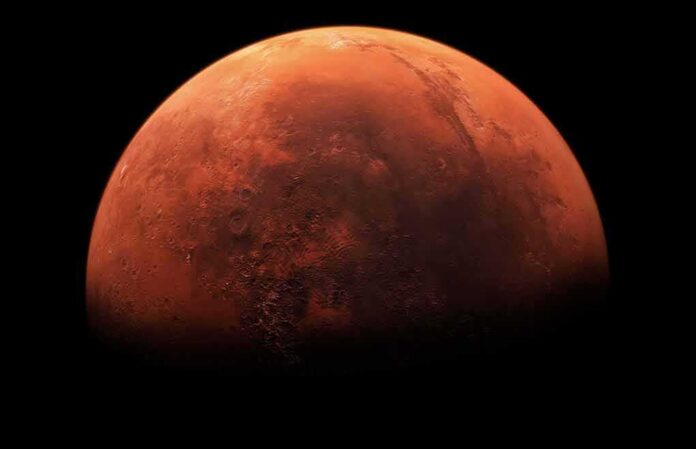
Japan just launched a mission to grab a piece of a Martian moon and bring it home—an audacious step that could reshape space science and strengthen allied leadership beyond Earth.
Story Snapshot
- Japan’s space agency launched the Martian Moons eXploration spacecraft toward Mars’s moons Phobos and Deimos.
- The mission aims to land twice on Phobos, collect about 10 grams of material, and return it to Earth in 2031.
- Australia plans to host the landing and recovery of the return capsule in 2031 as a partner nation.
- This is a key early step in a long, high‑risk sample‑return campaign, with major milestones still ahead.
Japan Confirms Clean Launch And Spacecraft Separation
Japan’s Aerospace Exploration Agency said the Martian Moons eXploration spacecraft lifted off on H3 Flight No. 10 at 4:41 a.m. Japan Standard Time from Tanegashima Space Center. The agency reported spacecraft separation about 71 minutes after launch and insertion into its planned orbit, marking a successful start to the trip toward the Martian system. News wires also reported the launch time and JAXA’s confirmation that the probe had begun its journey.
The launch matters because it opens the door to the first attempt to return samples from a moon of Mars. Japan’s plan is to cruise to Mars, survey both moons, and touch down on Phobos for two brief soft landings. The team designed the spacecraft to collect around 10 grams of surface material, stow it safely, and send it back to Earth. That is a long chain of tasks, but the first link—launch and separation—now holds.
What MMX Will Try To Do At Phobos And When
Mission planners state the spacecraft will spend time studying Phobos and Deimos to map terrain, pick safe sites, and learn about their makeup. The plan calls for two quick touchdowns on Phobos to gather a small but valuable sample. After those steps, the spacecraft will depart the Martian region in 2030 and send a sealed re‑entry capsule toward Earth for a 2031 landing. Agency documents describe each step as planned milestones still to come.
Allied partners frame the effort as a world first and a scientific leap. The National Aeronautics and Space Administration describes MMX as a Japanese‑led mission to explore both moons, collect a sample, and return it to Earth. That summary aligns with Japan’s plan and underscores the shared interest in how these moons formed and what they can teach us about the early solar system. Australia’s space agency confirms it will host the capsule’s landing and recovery in 2031, highlighting trusted cooperation among free nations.
Why This Matters For America’s Interests And Values
Allied strength in space supports American security, free markets, and technological edge. Japan’s successful launch shows that capable partners can lead complex missions while working closely with the United States and other democracies. That reduces reliance on rival states and keeps standards high for safety, data integrity, and openness. For American readers, this is a win for teamwork and for focusing public funds on clear goals with measurable steps, not on wasteful pet projects.
Caution still applies because the mission has years to go. The team must cruise to Mars, operate safely, land on a tiny low‑gravity world, collect a clean sample, then ship it home. Agency plans list 2031 for Earth return, which means many technical hurdles remain. Past attempts to reach or sample Phobos by other nations have failed, so each MMX milestone will stand on its own record. For now, the facts are clear: launch and spacecraft separation succeeded, and the campaign is underway.
Sources:
youtube.com, global.jaxa.jp, mmx.jaxa.jp, space.com