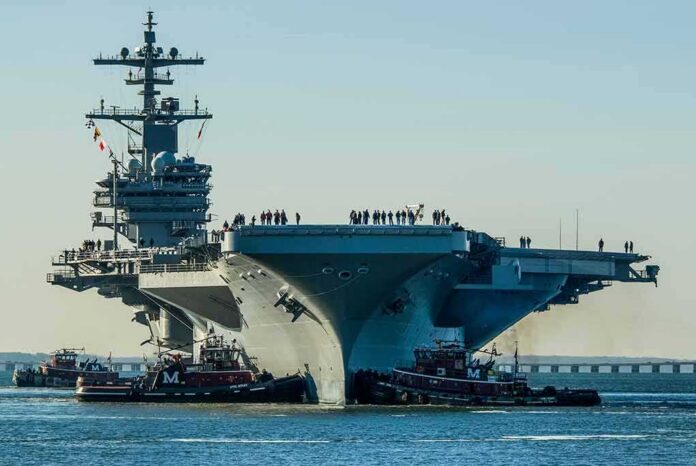
Trump has tied each Iranian ship attack to a new threat against bridges and power plants, turning the Strait of Hormuz fight into a blunt test of U.S. resolve.
Quick Take
- President Trump said one Iranian ship attack would trigger destruction of “one bridge or power plant.”
- The stated U.S. goal is to force Iran back to talks and protect shipping through the strait.
- Reports say U.S. strikes have already hit bridges, energy sites, and other infrastructure inside Iran.
- Iran and several outlets say the campaign is widening into civilian infrastructure, not just military targets.
Trump’s New Trigger-and-Strike Rule
President Trump warned that every time Iran fires on a ship in the Strait of Hormuz, the United States will destroy a bridge or power plant. In the clearest version of that threat, he wrote that “one bridge or power plant” would be bombed in response to each attack on shipping. That language leaves little room for doubt about the policy he is signaling.
Trump has repeated a broader version of the same message for months. He has said the United States would “knock out all their power plants” and “all their bridges” unless Iran returned to talks. Reuters and other outlets reported that he framed the strikes as part of a pressure campaign tied to the Strait of Hormuz and to Iran’s role in threatening commercial shipping.
Why the Administration Says It Is Acting
The White House and Central Command say the strikes are meant to restore safe passage in a vital waterway. AP reported that Central Command said the attacks were designed to “further degrade Iran’s ability to threaten civilian mariners and commercial vessels transiting regional waters.” Reuters likewise reported that the military said it was pressing Iran to lift its chokehold on the strait and keep international shipping moving.
That is the strongest public case for the administration’s position. If Iran is using maritime attacks to strangle trade, then striking logistics nodes tied to that effort can be presented as military pressure, not random punishment. But the public record released so far does not include strike packets, legal memos, or battle damage reviews showing why each bridge or power plant met that test.
Reports Say the Strikes Have Hit Civilian Infrastructure
Multiple outlets say the campaign has already reached bridges, energy facilities, water sites, and other civilian-use infrastructure. The Guardian reported that the United States hit bridges and energy facilities, while BBC Verify said it confirmed strikes on at least three bridges, two steel plants, and a pharmaceutical plant over two weeks. Al Jazeera and other reports also described damage to railways, water systems, and nearby neighborhoods.
(AP) Iran demands “US must permanently end the war, lift its naval blockade of Iranian ports and withdraw its military from the area. It also must ▶️▶️”completely compensate” Iran for war damage, lift sanctions and “unconditionally” release frozen assets.”
(Comment; NO chance… pic.twitter.com/1D3uZ6H1zu
— Ron Strauss, Esq (@RonStrauss1) August 9, 2026
That reporting creates a serious political and legal problem for the administration. Civilian infrastructure is generally protected unless it is being used for military purposes, and the public sources here do not show site-by-site proof that every target was being used that way. Iranian officials and state media also disputed the U.S. claim that the strikes were limited to military targets.
The Political Risk Is Escalation, Not Deterrence
Trump’s one-for-one threat is easy to understand, but it is also easy to escalate. A fixed rule tied to ship attacks can quickly pull the United States into a cycle where each new Iranian strike triggers a broader blow against infrastructure. That may satisfy voters who want strength, but it also raises the cost of every round and makes de-escalation harder once the pattern starts.
Iran is already using the U.S. strikes to argue that Washington is targeting civilian life-support systems instead of military assets. Reports describe deaths, injuries, power strain, and water disruption, including claims that a desalination plant was destroyed and left villages without water. Even if the administration believes it is striking lawful targets, the public debate is now centered on whether the campaign is crossing the line into civilian harm.
Sources:
19fortyfive.com, bbc.com, theguardian.com, aljazeera.com, wsws.org, washingtonpost.com, youtube.com, reuters.com, apnews.com, wbaltv.com, ms.now, yahoo.com, npr.org, nytimes.com