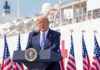

After a cargo ship was hit by Iranian drones, Vice President Vance warned Tehran that more attacks will be met with force.
Story Snapshot
- U.S. says Iran violated a ceasefire by striking a Singapore-flagged ship with drones [1].
- U.S. forces hit Iranian missile, drone storage, and radar sites in Sirik and Qeshm [4].
- Vice President Vance warned Iran that any new attacks will face swift U.S. action.
- CENTCOM called Iran’s strike “unwarranted aggression” that threatened free navigation [3].
Vance’s Message to Tehran: Attacks Will Bring Consequences
Vice President J. D. Vance warned Iran that any further attacks on commercial ships will be met with force. His statement followed a drone strike that hit the Ever Lovely, a Singapore-flagged vessel, as it transited near the Strait of Hormuz. President Donald Trump called the attack a violation of the ceasefire and a foolish breach of the new understanding with Tehran [1]. The warning from the White House signals that the United States will act to keep sea lanes open and to protect global trade from coercion.
United States Central Command confirmed the attack and labeled it “unwarranted aggression” that violated the ceasefire and threatened freedom of navigation [3]. Officials said four drones were launched, three were shot down, and one damaged the ship’s upper deck [10]. U.S. forces then struck targets inside Iran tied to drones and missiles, along with coastal radar sites that help cue such attacks. Military officials described the response as proportional and focused on deterring repeat strikes [1].
What Was Hit and Why It Matters for Free Navigation
Central Command and U.S. officials said the strikes targeted storage locations for drones and missiles, plus radar sites in Sirik and on Qeshm Island, which help track and target shipping [4]. Hitting radar and stocks reduces Iran’s ability to harass commercial vessels. The Ever Lovely was reportedly using a route recommended by the British Navy, which Iran had warned against in favor of a northern path closer to Hormuz Island [6]. The United States argues Tehran cannot dictate tolls, routes, or threats in an international strait.
Iran has pushed a claim that only Tehran-approved routes are safe, and some outlets repeated Iranian officials calling the U.S. response a reckless violation of the ceasefire. But Iran has not admitted this specific drone strike on the Ever Lovely. No photos of the ship’s damage have been released yet, which limits public verification. Still, the stated facts from the United States about the drone launches and the specific U.S. targets hit inside Iran carry official weight and a clear deterrent purpose [1].
Ceasefire Gray Areas and the Risk of Spin
Reporters noted the memorandum is an interim understanding, not a formal treaty. That gives critics room to argue about terms. Some coverage also said the document does not spell out drone limits, which the media used to question the U.S. violation claim. The White House response rests on a plain idea: commercial vessels must pass freely without state-backed drone attacks. Central Command’s label of “unwarranted aggression” anchors that case in maritime reality, not legal hairsplitting [3].
The strait has seen this playbook before. Armed groups and states use drones to threaten cargo traffic and drive political goals. Since the late 2010s, drone harassment of ships surged in the region, making escorts, jamming, and quick strikes more common tools to keep routes open [12]. When a regime claims control over international lanes, shippers pay more, fuel costs rise, and families here feel it. Keeping the lanes open is not war-mongering. It is basic defense of our economy and our allies.
What Comes Next: Deterrence, Proof, and Pressure
The administration says the goal is deterrence, not escalation. Officials characterized the strike as the first inside Iran since the new understanding took effect and as a measured answer tied to a specific drone attack [1]. More proof can further harden the U.S. position. Satellite tracks of the ship’s route, declassified drone telemetry, and debris analysis would help put doubts to rest. A captain’s log and British Navy radar records could also document compliance and warnings, if any exist.
Iran accuses US of violating war-ending deal after exchange of strikes
Tehran says Washington breached ceasefire with attacks on Iranian territory as both sides trade fresh military blows linked to Strait of Hormuz
🔗: https://t.co/08IDIE70AL pic.twitter.com/KxpU9SptIk
— Kurdistan 24 English (@K24English) June 27, 2026
For conservatives, the core test is simple. Does Washington defend free passage and American credibility without drifting into endless war or yielding to global bullies? The administration’s message, echoed by Vice President Vance, is that the United States will not accept tolls, fake “approved” corridors, or drone ambushes in an international chokepoint. That stance protects energy supplies, restrains inflation pressure, and upholds a basic rule: rogue actors do not get to tax or terrorize the world’s trade lanes.
Sources:
[1] YouTube – US strikes Iran after cargo-ship attack in Strait of Hormuz
[3] Web – U.S. strikes Iran in response to drone attack on cargo ship that Trump …
[4] Web – ️ US strikes Iran after drone attack on cargo ship in Strait of Hormuz …
[6] Web – US launches strikes on Iran in response to drone attack on cargo ship
[10] YouTube – Iran strikes vessel in Hormuz; US pushes to keep traffic flowing …
[12] YouTube – US strikes Iran in response to drone attack on ship in Strait of …