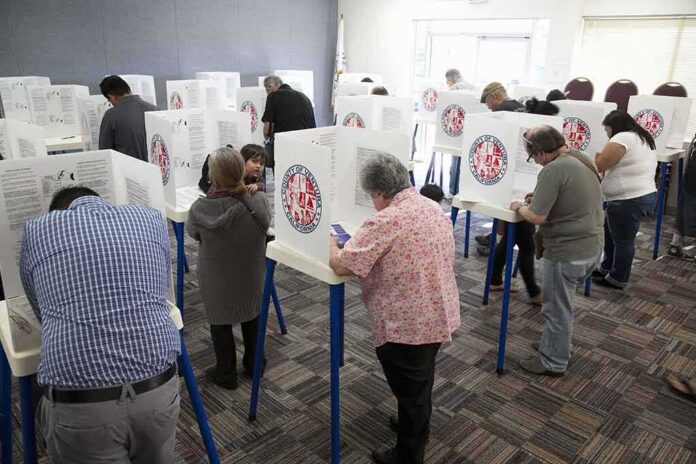
The Justice Department plans to send a record 1,000 monitors to polling places across the country for the November midterms, the largest such deployment in the agency’s history.
Story Snapshot
- The Justice Department will deploy roughly 1,000 election monitors nationwide for the 2026 midterms, according to Assistant Attorney General Harmeet Dhillon.
- The Department already sent monitors to Michigan, Minnesota, Florida, and Wyoming during earlier primaries this year.
- Some Democratic senators are pressing the Department for details on how monitors are chosen and deployed.
- Federal law lets the Justice Department watch polling sites, but local officials can limit monitors to outside the building.
Justice Department Confirms Record Deployment
Bloomberg reported on August 17, 2026, that the Justice Department plans to send about 1,000 monitors to watch voting during the midterm elections. Assistant Attorney General Harmeet Dhillon confirmed the number, calling it the largest monitoring effort the Department has ever run for a single election cycle.
The Department has framed the effort as a straightforward compliance mission. Officials say the goal is to check that polling places follow federal voting rights laws, protect ballot security, and keep the process transparent for every voter, regardless of party or location.
Michigan Cities Named as Early Targets
The Department already put the plan into action before the midterms. A Justice Department press release named Detroit, Hamtramck, Lansing, and East Lansing as sites where staff from the Civil Rights Division’s Voting Section would monitor polling places, alongside attorneys from two Michigan U.S. Attorney’s Offices. Naming specific cities and staff shows this was a real operational plan, not just a talking point.
Minnesota also saw monitors on Election Day earlier this year. A local news report noted that the Minnesota Secretary of State’s office pointed to the earlier Michigan deployment as proof the process runs routinely and without incident. Even so, some counties pushed back on how far monitors could go inside buildings.
Legal Authority Rests on the Voting Rights Act
The Justice Department’s own guidance explains where this authority comes from. The Civil Rights Division says it conducts election monitoring under the Voting Rights Act, which allows federal observers into certain counties or states that meet specific legal conditions. That law has protected voters from discrimination at the polls since Congress passed it in 1965.
Court rulings have narrowed how that power works. After the Supreme Court’s 2013 Shelby County decision, federal observers lost the automatic access they once had in covered states. For nearly 50 years the program had served as a direct check on discrimination at polling sites, but the ruling forced the Department to rely more on local consent or court orders to get inside buildings.
Florida and Wyoming Primaries Already Monitored
The pattern continued into late summer. On August 18, 2026, the Justice Department announced it was monitoring polling sites in Florida and Wyoming during their primary elections. The release stated plainly: “Thus far the DOJ has deployed over 75 monitors across five states and over 200 polling locations this primary season”. That cumulative count gives a real-world benchmark for how the 1,000-monitor midterm target compares to earlier primary activity this year.
Senators Press for Details on Deployment
Not every lawmaker has welcomed the news quietly. Senator Mark Warner and Senate colleagues sent a letter pressing the Justice Department for a fair and legal process behind the deployment, asking how jurisdictions get chosen and what rules govern monitor conduct once they arrive. Conservatives argue that question cuts both ways: voters have every right to know monitors follow neutral, lawful standards, and that is exactly what election integrity enforcement should look like.
Local governments still hold real leverage over how monitors operate. Under a 2013 Supreme Court ruling, Justice Department monitors can only enter a polling place with local officials’ agreement, unless a court order says otherwise. Without that agreement, monitors stay outside and talk to voters in public areas instead. That balance keeps federal oversight in place while respecting the authority states and counties hold over running their own elections.
For an administration focused on restoring faith in the ballot box, a record monitor deployment sends a clear signal. President Trump’s Justice Department has made election integrity a stated priority, and putting more federal eyes on polling places, backed by existing law, is a direct answer to years of voter concern over ballot security. The scale alone marks this as one of the most significant monitoring efforts since the Voting Rights Act became law.
Sources:
cbsnews.com, bloomberg.com, justice.gov, aljazeera.com, pbs.org