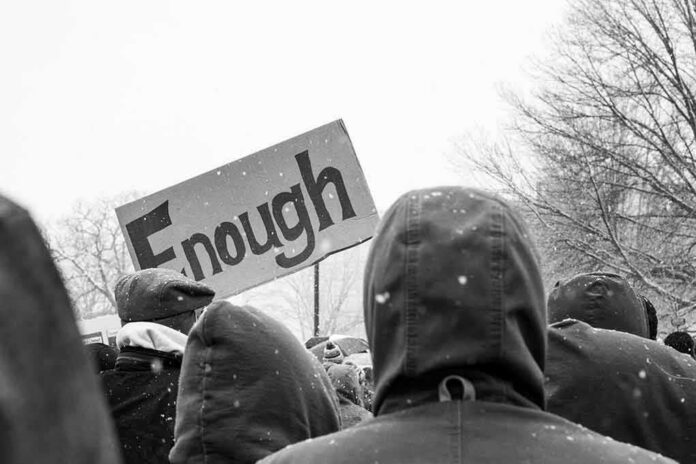
The State Department just branded four violent European anti-fascist networks as terrorist organizations, right as riots tied to anarchist activity tear through France, Belgium, Italy, Portugal and Spain.
Quick Take
- The State Department designated four violent far-left groups as terror organizations and offered rewards up to $10 million for information on their finances.
- Belgium’s interior minister called the Brussels unrest “organized violence,” not random chaos.
- Riots have spread from Paris to Belgium, Italy, Portugal and Spain over the past several weeks.
- Russia-linked networks amplified the unrest online, though no proof shows foreign powers started the riots.
- Left-leaning critics claim antifa has no command structure, but Washington says the violence is real enough to act on.
State Department Targets Violent Far-Left Networks
Secretary of State Marco Rubio announced the designation of four European groups, Antifa Ost, the Informal Anarchist Federation/International Revolutionary Front, Armed Proletarian Justice and Revolutionary Class Self-Defense, as Foreign Terrorist Organizations and Specially Designated Global Terrorists. The State Department is offering rewards of up to $10 million for information that helps disrupt their funding networks.
These are not fringe groups invented for a press release. The Informal Anarchist Federation is based in Italy and claims affiliates stretching across Europe, South America and Asia. For years these networks have been tied to bombings, arson and attacks on infrastructure, while American officials looked the other way. That era is over.
Unrest Spreads From Paris to Brussels and Beyond
What started as scattered French protests has turned into a continent-wide problem. Demonstrations have hit France, Belgium, Italy, Portugal and Spain, with arrests and street clashes piling up in multiple capitals. Belgium’s interior minister did not mince words, describing the violence in Brussels as “organized violence” rather than spontaneous unrest.
That matters. When a government official on the ground calls it organized, it undercuts the media narrative that this is just disconnected, grassroots frustration boiling over. Something is driving crowds to turn violent in city after city, and officials are starting to say so out loud.
Local Grievances Fuel the Flames
The spark in France came from students angry about crumbling schools, teacher shortages and education funding, which then grew into a broader fight over the cost of living. Italy’s protests center on wages and prices. Belgium’s are tied to education. Portugal’s revolve around housing costs and pay. Each country has its own list of complaints.
That is a real weakness in any claim that one single network is pulling every string across five countries. The grievances differ by nation, and no evidence has surfaced showing the designated terror groups directed these specific protests. Solidarity between student groups in Belgium and Italy has been reported, but coordinated international action has not been proven.
Foreign Actors Exploit, Don’t Spark, the Chaos
Investigators have found Russia-linked disinformation networks, including operations known as Overload and Doppelgänger, amplifying the violence online. But reporting makes a key distinction: there is no conclusive evidence foreign powers caused the riots, only that they piled on once the fires were already burning. Brussels has reportedly declined to act further, citing insufficient evidence of direct foreign orchestration.
That is an important caution for anyone tempted to blame Moscow or Beijing for every burning car in Paris. But it cuts both ways. The absence of a smoking gun proving foreign control does not mean the violent networks on American soil and abroad are harmless street theater. It means the investigation is ongoing, and Washington is right to get ahead of it.
Skeptics Downplay the Threat
Critics argue the antifa label is overblown, noting the movement lacks a membership roll, a command hierarchy or centralized funding, and that violence by unrelated actors is sometimes wrongly pinned on it. That is a fair point worth weighing. But it does not erase the fact that named, documented organizations with real attacks on their record now carry formal terrorist designations, backed by seven-figure rewards for information on their money trail.
For a conservative audience that has watched left-wing street violence get excused as “mostly peaceful” for years, this is a welcome shift. The Trump administration is drawing a hard line between political protest, which is protected, and organized violent extremism, which is not. Europe’s burning streets are proof the distinction can no longer be ignored.
Sources:
youtube.com, state.gov, studioglobal.ai, theconversation.com, ksl.com