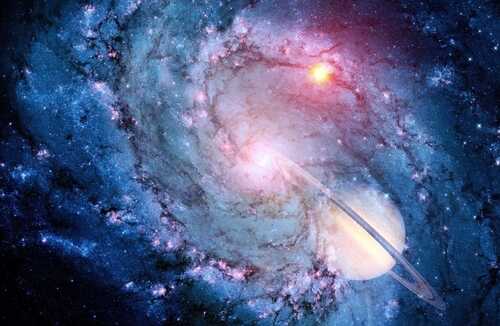
NASA and the James Webb Space Telescope have revealed that two black holes collided when the cosmos was just 740 million years old—roughly a twentieth of its current age—forming a supermassive black hole and shedding new light on early galactic evolution.
At a Glance
- Researchers observed a merger between two ancient black holes in the early universe using James Webb data.
- The event occurred when the universe was approximately 740 million years old.
- The merger formed a single, more massive black hole, providing insight into how early supermassive black holes grew.
- The system, dubbed ZS7, revealed one black hole with an estimated mass of 50 million solar masses.
- Findings suggest that roughly a third of black holes at that epoch were undergoing similar mergers, hinting at a widespread growth mechanism.
Ancient Collisions, Modern Revelations
Astronomers, using the James Webb Space Telescope, have identified a collision between two black holes in the early universe—when it was merely 740 million years old. This collision merged the black holes into one supermassive black hole within the system known as ZS7, with at least one of the components estimated at 50 million times the mass of the Sun. This event offers rare empirical evidence of how such titanic entities could form in the first billion years of cosmic history.
Watch now: Two Black Holes Merge into One
Rethinking Supermassive Black Hole Formation
Prior theories posited that early supermassive black holes grew either by rapidly accreting vast amounts of matter or by originating from unusually large seeds. However, this new observation points to a third plausible pathway: frequent early mergers. In fact, analyses indicate that roughly one in three black holes during that era may have been merging, making collisions a potentially key driver in the rapid buildup of cosmic giants.
Why This Matters Now
Although black hole mergers have been detected since 2015 with LIGO—thanks to gravitational wave signatures from black holes with 26 to 36 solar masses—the newly detected event stands out due to its sheer age and scale. It offers a window into the infancy of the universe, illuminating the mechanisms behind early structure formation. These insights are critical for refining cosmological models and understanding the origins of supermassive black holes—like the one anchoring our own Milky Way.