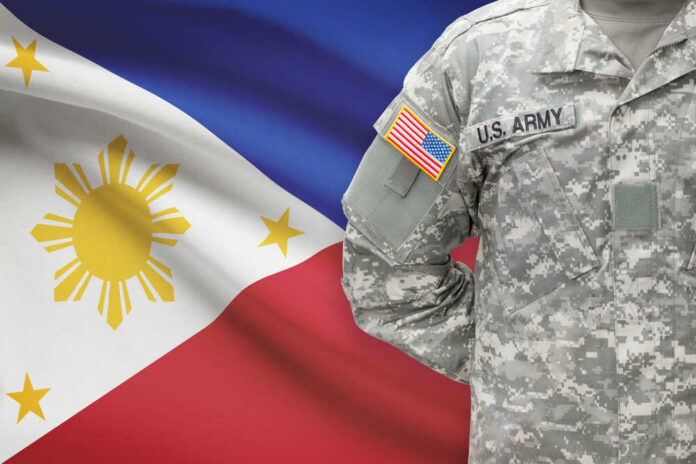
America is now drilling for a Pacific showdown while fighting in the Middle East—an unmistakable sign that global threats are converging faster than Washington’s bureaucracy can adapt.
Quick Take
- The U.S. and Philippines launched their largest-ever Balikatan exercises on April 20, running through May 8 with more than 17,000 troops.
- Australia, Japan, Canada, France, and New Zealand joined as full participants, with observers from 17 additional nations.
- The drills emphasize maritime security, coastal defense, and “integrated fires” as China pressures Philippine forces near disputed reefs.
- The timing overlaps with the Trump administration’s new naval blockade of the Strait of Hormuz during a U.S.-Israeli war with Iran, raising the stakes of multi-theater deterrence.
Record-Scale Balikatan Signals a Hard Pivot to External Defense
U.S. and Philippine forces began the 2026 Balikatan (“shoulder-to-shoulder”) exercises on April 20, with activities scheduled through May 8 and participation topping 17,000 troops. The roster includes full participants from Australia, Japan, Canada, France, and New Zealand, plus observers from 17 more countries. Organizers describe a focus on warfighting fundamentals—maritime security, coastal defense, and integrated fires—rather than symbolic cooperation.
US begins 'biggest ever' Philippines war games in thick of Mideast conflicthttps://t.co/hxSjJo69B0
— Insider Paper (@TheInsiderPaper) April 20, 2026
U.S. Marine officials framed the drills as preparation to face “any challenge, together,” while Philippine leadership emphasized the need to meet threats jointly. The scope matters because the Philippines has been shifting from internal security priorities toward external defense, especially in waters where China’s expansive territorial claims overlap Manila’s exclusive economic zone. In practice, Balikatan has become a visible test of whether treaty allies can operate as a coherent fighting force under pressure.
South China Sea Friction Is Driving the Tempo—and the Locations
Chinese-Philippine tensions spiked just before the exercises, when Chinese forces fired flares at a Philippine coast guard aircraft over Mischief Reef and Subi Reef. Those incidents sit inside a larger pattern: China’s militarized artificial-island footprint and aggressive enforcement of its claims. Balikatan’s training lanes—along the Philippines’ west coast facing the South China Sea—signal that Manila and Washington expect future crises to be maritime and fast-moving.
Military planners are also building for a wider fight by rehearsing multi-domain coordination. Reported activities include maritime operations such as deck landings, live-fire gunnery, and anti-submarine warfare, plus land-based components tied to coastal defense and long-range fires. The exercise geography—such as areas near Palawan (facing the Spratlys) and northern sites facing Taiwan—underscores an uncomfortable reality: any serious regional conflict would not stay neatly confined to one flashpoint.
EDCA Base Access Expands U.S. Options, but Raises the Political Heat
Balikatan’s growth tracks with expanded U.S. access under the Enhanced Defense Cooperation Agreement, which now covers nine sites, including locations that shorten response times to South China Sea contingencies and potential Taiwan spillover. Supporters argue these locations improve logistics and deterrence by making it harder for adversaries to assume the U.S. cannot surge forces quickly. Critics, especially in Beijing, view the posture as tightening encirclement and increasing provocation risk.
The tension for American voters is familiar: credible deterrence requires readiness, but readiness requires spending, basing, and sustained attention from a federal apparatus that often looks distracted. Conservatives who demand strength abroad while pushing discipline at home will see the tradeoffs in real time—because large-scale deployments, munitions stocks, and sustainment all compete with domestic priorities. At minimum, the administration and Congress will have to explain the cost and end state with more clarity than past “forever” commitments.
Hormuz Blockade Timing Connects the Indo-Pacific to Middle East Escalation
The Balikatan launch coincided with President Trump initiating a naval blockade of the Strait of Hormuz amid a U.S.-Israeli war with Iran. That overlap matters less as a headline and more as a stress test: adversaries watch whether the U.S. can deter in the Pacific while also applying pressure in the Middle East. Even without a new shooting war in Asia, the perception of stretched bandwidth can invite miscalculation—especially around contested reefs and airspace.
The alliance is training for harder scenarios, and the U.S. is signaling that deterrence is not optional even when other crises consume attention. That reality will keep testing whether Washington can act like a functional government.
Sources:
From China to Iran: 17,000 troops join biggest US-Philippines war drills as war threats grow
US-Philippines military exercise largest ever amid rising tensions with China
US, Philippines to hold their largest ever war games
US, Philippines to hold their largest-ever war games