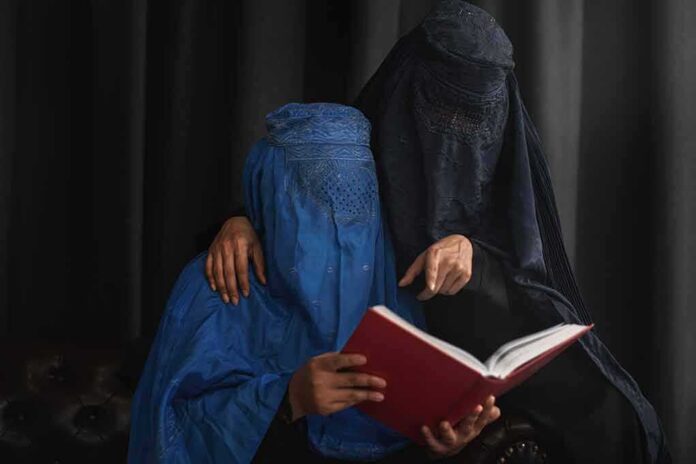
Afghan girls banned from school are studying in secret rooms, risking arrest to keep learning, even as millions remain locked out by Taliban edicts.
Story Highlights
- About 2.2 million Afghan girls were excluded from schooling beyond primary in 2024
- Reports document underground classes and closures of girls’ madrassas in Kabul in 2025
- Secret schools and online lessons persist but face weak internet and funding cuts
- Surveys show over 90 percent of Afghans want girls’ education to continue
Documented Exclusion Drives Underground Learning
United Nations and education reports state that Afghan authorities barred girls from education beyond grade six nationwide after August 2021. By 2024, about 2.2 million girls were out of secondary school, a stark number that explains why secret classes exist at all. Community groups and families have responded with quiet, home-based lessons to fill the gap. These efforts keep basic skills alive, but they operate under risk and without the formal recognition many students need for future study.
United Nations human rights monitors recorded closures of girls’ learning spaces in Kabul during 2025. On August 23, officials shut three girls’ madrassas for admitting older students and for teaching science subjects like mathematics, chemistry, physics, and biology, citing dress and curriculum rules. Such shutdowns show the enforcement bite behind the bans. They also reveal why many lessons now meet behind curtains, with lookouts at the door and textbooks tucked inside sewing bags.
How Secret Schools Operate Under Pressure
Named reporting has tracked small, hidden classrooms in Kabul and in provinces like Parwan and Herat. One account highlighted a 21-year-old teacher, Nazanin, who gathered teens for math and language in a private home to avoid raids. European country-analysis says these underground lessons and online modules remained a lifeline into 2026, though not all families can reach them. Weak connectivity and fewer aid dollars often break the chain between eager students and steady lessons.
These improvised schools are not equal to a normal high school. Some teachers are very young, many lack training, and classes cannot always cover full science labs or recognized exams. Still, they keep girls reading, writing, and solving problems while formal doors stay shut. That matters for basic freedom and for any chance to re-enter formal classes later. The work is brave and fragile. When a local official loosens pressure, attendance rises. When a patrol shows up, the classroom vanishes.
What Afghans Say Versus What Officials Claim
A nationwide survey by United Nations Women found that about 92 percent of Afghans believe girls should keep going to school, across rural and urban areas and among both men and women. That support undercuts the claim that bans reflect broad public will. Taliban spokesmen have argued that what outsiders call secret schools are simply homeschooling or religious study, and that alternatives exist while public secondary is suspended. But recorded closures of science-teaching madrassas and the scale of exclusion tell a different daily reality.
Even within Taliban ranks, views clash. A senior Taliban official publicly said the education ban lacks a basis in Islamic law and harms millions. His stance shows internal debate, but the policy on the ground still blocks girls after grade six. Until orders change, families will keep turning living rooms into classrooms. That is the clearest vote of confidence in learning anyone can make—parents risking safety so their daughters do not lose their future.
Limits, Risks, and What Comes Next
European analysis warns that internet instability and funding cuts weaken online courses and private tutoring. Many homes lack devices or steady power, so only some girls can join virtual lessons. Others depend on rotating home circles that meet when streets are quiet. These limits mean underground education is a stopgap, not a full fix. Students need tested curricula, safe buildings, and recognized exams to move on to jobs, training, or college when doors finally reopen.
🔴 Afghan women open secret schools, salons despite Taliban bans since August 2021
Women in Kabul are defying Taliban restrictions through clandestine businesses and education. Taliban law bans schooling beyond primary grades for girls, closes beauty salons, and bars women from… pic.twitter.com/aDKIZznHZE
— NewsTongue (@NewsTongueX) November 17, 2026
For American readers, this story is about basic rights and common sense. Education builds self-reliance, grows economies, and pushes back on extremist control. The numbers and closures are clear, the public support inside Afghanistan is strong, and the courage of teachers and parents is beyond dispute. Policymakers should back secure, verifiable programs that keep girls learning now and prepare for a rapid return to formal schooling later. Freedom’s seed is still being planted, one secret lesson at a time.
Sources:
independent.co.uk, euaa.europa.eu, articles.unesco.org, unsom.unmissions.org, unwomen.org