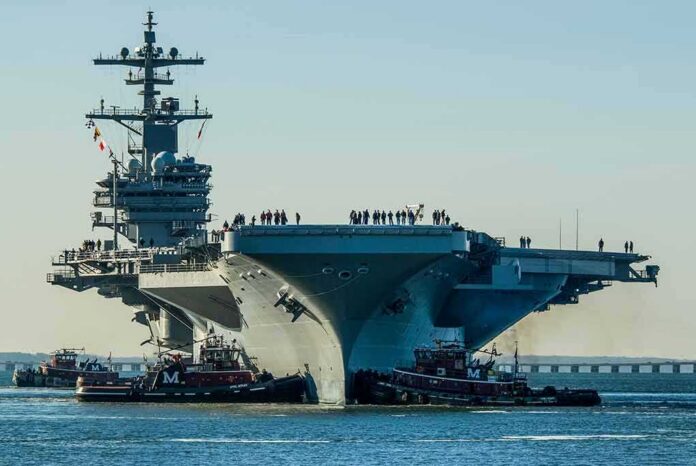
A sweeping new Trump plan aims to end America’s dependence on foreign-built ships and put U.S. shipyards back to work.
Story Snapshot
- Trump’s Maritime Action Plan uses fees on foreign-built ships to fund a U.S. shipbuilding revival.
- A new Maritime Security Trust Fund is designed to give steady, protected money for American yards.
- Maritime Prosperity Zones and allied investments aim to bring jobs and steel back to U.S. ports.
- Globalists, green activists, and some economists attack the plan but offer few hard alternatives.
Trump’s Maritime Action Plan Targets Years of Decline
For decades, Washington talked about rebuilding U.S. shipbuilding while shipyards closed and China took over the seas. Today China has massive shipyard capacity and builds ships at a fraction of U.S. costs, leaving America dangerously dependent on foreign hulls for trade and even key supplies. President Trump’s Executive Order “Restoring America’s Maritime Dominance” ordered a real plan, not another study, and set the stage for a full Maritime Action Plan to turn policy into steel and jobs.
The Maritime Action Plan is the White House blueprint to reverse that decline. It centers on boosting domestic shipbuilding and repair capacity, strengthening the maritime industrial base, and expanding the U.S.-built and U.S.-flagged commercial fleet. Unlike past vague efforts, it lays out concrete steps: more investment in yards, incentives for private capital, and coordinated action across defense, transportation, labor, and trade agencies so federal work actually lines up instead of fighting itself.
How the Plan Raises Money and Backs U.S. Yards
The heart of this push is money that cannot be easily yanked away by the next Congress or the next round of lobbyists. Trump’s order directs a legislative proposal for a **Maritime Security Trust Fund** as a reliable, dedicated source to support Maritime Action Plan programs. The idea is simple: use tariff, fine, fee, or tax revenue linked to foreign shipping to finance American shipyards, maritime workers, and a larger U.S. merchant fleet instead of padding foreign bottom lines.
To fill that fund, the plan backs a universal fee on foreign-built commercial ships that call at U.S. ports, assessed on cargo tonnage no matter where the ship is flagged. White House estimates say that over a decade this fee could bring in tens of billions of dollars for yard upgrades, new construction, and maritime security programs. Critics sneer that the fee range is too broad, but they have not produced solid data showing that such revenue is impossible or illegal; they mostly complain about design, not the core concept.
Maritime Prosperity Zones, Deregulation, and Allied Help
The plan also tries to fix the map of American shipbuilding. New **Maritime Prosperity Zones** would steer private and allied investment toward U.S. maritime communities, not just long-established yards. These zones are meant to cut red tape, offer tax and regulatory breaks, and align state, local, and federal incentives to bring back industrial jobs to coastal and river regions that global trade deals hollowed out. Longtime conservative analysts have argued this kind of targeted support is key to attracting capital.
The Maritime Action Plan leans on deregulation to make U.S. yards more competitive without handing permanent control to Washington bureaucrats. It calls for trimming overlapping rules and unifying shipbuilding efforts across agencies so builders face one clear path instead of a maze of mandates. At the same time, Trump has pushed historic shipbuilding cooperation with allied nations such as South Korea and Japan, drawing investment into U.S. facilities to expand capacity and reduce dependence on Chinese yards.
Security Stakes and the Fight with Globalists and Greens
National security experts, including many not tied to the administration, warn that the current state of U.S. shipbuilding is a real vulnerability. The Government Accountability Office has documented that the Navy’s shipbuilding and repair base already struggles to deliver vessels on time, even before a major wartime surge. Policy studies note that without new investment and stable demand, the United States will stay dependent on foreign yards that may not share our values or interests.
Despite that, left-leaning environmental groups and some think tanks attack the Trump plan as a “missed opportunity” for green shipping and call its fees “laughable” without offering a rival funding plan with hard numbers. They argue the plan does not go far enough on new fuels, yet they offer little comfort to workers who watched “green” agendas kill coal plants, pipelines, and refinery jobs. Many of these critics also spent years defending global trade policies that helped offshore American shipbuilding in the first place.
Political Roadblocks and What Comes Next
The biggest threat to this shipbuilding push may not be economics or engineering, but politics. Senate Democrats have already used procedural fights on defense bills to stall or weaken broader defense and industrial base spending, signaling trouble for any major Trump-backed maritime funding package. If Congress refuses to move on the trust fund or guts the universal fee, the same establishment that let our shipyards rust out will get yet another veto over America’s industrial future.
Right now I am writing this in tears. Thank you @SECNAV @HungCao_VA from the bottom of my heart.
The US Merchant Marine has been defunded, denigrated, and stripped of respect for decades.
The result? The Navy pulled 17 critical logistics ships manned by Merchant Mariners from… https://t.co/s5hv5JrwDk
— John Ʌ Konrad V (@johnkonrad) July 14, 2026
For conservatives, the stakes are clear. A strong, self-reliant maritime sector means secure supply lines in a crisis, good blue-collar jobs at home, and less leverage for Beijing and global shipping giants over our economy. The Trump Maritime Action Plan does not solve every problem, and details like fee levels and project choices will matter. But for the first time in a generation, Washington is putting American shipbuilding, not global shipping profits, at the center of national policy.
Sources:
youtube.com, whitehouse.gov, reuters.com, breakingdefense.com, nationaltoday.com, insidedefense.com, klgates.com, pacificenvironment.org, winston.com, linkedin.com, facebook.com, amo-union.org, independent.org, news.usni.org, enotrans.org, files.gao.gov