
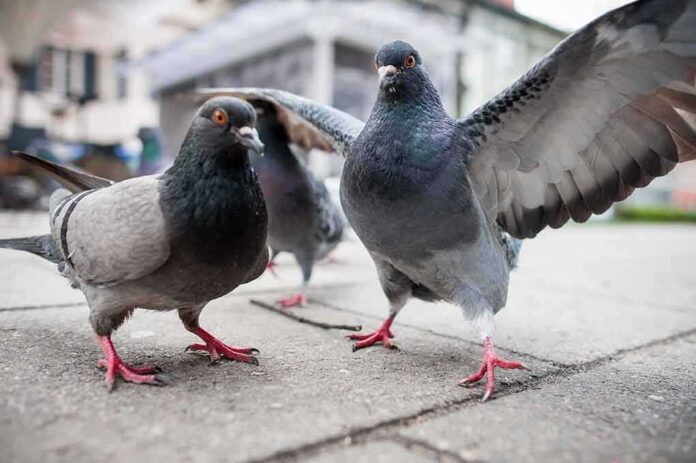
European birds let men walk about three feet closer than women before flying off, and scientists do not know why.
Story Highlights
- Researchers across five European countries found birds flee sooner from women than men.
- The gap averaged about one meter, or roughly three feet, across 37 urban bird species.
- Trained male and female observers were matched for height and clothing to reduce bias.
- Scientists measured “flight initiation distance,” a standard escape-response metric.
Large, Cross-Country Study Reports A Consistent Flight Gap
Researchers working in Czechia, France, Germany, Poland, and Spain walked toward urban birds and measured how close they could get before the birds took flight. Reports say the team logged more than 2,500 encounters and covered 37 species, from pigeons to woodpeckers. On average, men could approach about one meter closer than women before birds bolted. That pattern held across countries and species, according to summaries of the peer-reviewed paper in People and Nature.
The study used a standard measure called flight initiation distance. That is the point where a bird decides to flee. The observers approached at a set pace to keep things fair. Multiple outlets report the one-meter gap and the wide sample. The researchers did not claim a cause. They noted possible cues like scent or gait but did not test them. The bottom line is simple: in this setup, birds fled earlier from women than from men.
Methods Aimed To Limit Confusion While Leaving Cause Open
Reports say the study paired four male and four female expert ornithologists. They matched height and clothing to reduce obvious visual cues. That helps rule out simple factors like one group looming larger. Even with those controls, the sex-linked gap in escape distance appeared across many sites. The summaries do not list confidence intervals or model details, so the exact precision is not provided in public write-ups. The authors themselves say the reason for the gap is unknown.
The result sits within a broad field that studies how close animals let people come. Prior work shows urban birds usually allow closer approaches than rural birds. Exposure to people changes behavior over time. Body size and habitat also matter. Those patterns help explain overall tolerance but do not explain the new sex difference. This study adds a fresh twist to a known tool and invites targeted tests to find the cue that birds read as a signal to flee.
What The Finding Means—and What It Does Not
The finding describes behavior in one clear context: a person walking toward a bird in a park. It does not claim that birds fear women more in every setting. It does not measure stress hormones or feeding. It shows a difference in one escape distance during approach. That is still notable, because the team saw it across many countries and species. The size of the effect—about three feet—would be obvious to anyone who photographs or counts birds in city parks.
Scientists can test next steps with simple trials. They can mask scent, alter gait, or use recorded voices while keeping the same walker. They can add more ages and body types to see which trait the birds track. They can test beyond Europe and across seasons. Until then, the clearest takeaway is this: when people walk straight at them, urban birds let men get closer than women before taking off. The mechanism remains an open question worth real lab and field time.
Sources:
sciencedaily.com, smithsonianmag.com, phys.org