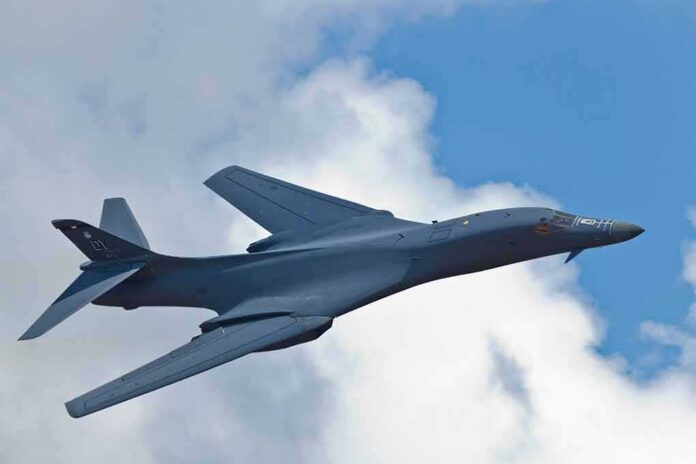
British counterterrorism police arrested a seventh man tied to a security incident near a U.S.-run air base, after which the Pentagon confirmed all American bombers at RAF Fairford returned to the United States.
Story Highlights
- Seven arrests followed a security incident near RAF Fairford, a U.S.-run bomber hub in England.
- The Pentagon said every U.S. bomber at Fairford redeployed to home stations in America.
- Officials framed the move as a precaution to protect U.S. forces while probes continue.
- British police examined multiple vehicles with military and forensic support.
Pentagon Confirms Redeployment Of U.S. Bombers To Protect Forces
The Pentagon said all American bombers previously deployed to Royal Air Force Fairford were sent back to their home stations in the United States. Officials stated that operational security limited real-time disclosure, but they could now confirm the movement. The Department of Defense said bomber forces continue to operate worldwide and remain ready for global strike missions. Vice President JD Vance described the action as taken out of caution to protect American service members, aligning with the Pentagon’s posture.
Reporting identified the deployed fleet as including B-1 bombers, with some accounts noting B-2 and B-52 aircraft as well. Outlets varied on the exact count, with several citing about a dozen aircraft involved. Despite those differences, the consistent point remains that the entire bomber presence at Fairford was removed after the security incident. U.S. officials emphasized that the change did not reduce strategic reach. They stressed that forces could surge back as needed.
British Counterterrorism Probe Advances With Arrests And Vehicle Searches
Counter Terrorism Policing in the United Kingdom confirmed an active investigation linked to the incident near RAF Fairford. Authorities said the inquiry was in its early stages. Investigators conducted an extensive examination of three vehicles with support from military and forensic specialists. Initial arrests began on September 27, and suspects were later bailed as searches continued. Officials appealed for public tips while stressing methodical steps to secure the area and gather evidence for any charging decisions.
British media reported that five men were arrested first and later bailed, with additional arrests following as leads developed. Police used bomb disposal support and robotics while examining vans near the base. The timing of the arrests preceded the Pentagon’s confirmation that bombers departed. That sequence showed a coordinated security posture across both governments. Authorities did not release a detailed charge sheet at this stage, which is common during early counterterrorism work.
Timeline And Rationale: Caution Drives Action Amid An Early-Stage Case
BBC and other outlets reported arrests beginning on September 27, with the United States confirming bomber redeployment on October 4. That timeline placed the aircraft movement shortly after police activity around the base began. U.S. leaders publicly framed the action as protective and precautionary. They stressed that the United States Air Force can operate from many locations and did not lose capability by returning aircraft to home bases while British officers advanced their probe.
The United States has indeed withdrawn all heavy bombers from RAF Fairford in the UK. According to *The New York Times*, citing two US officials, this urgent withdrawal was ordered on or around Saturday, October 3, 2026, after commanders received new intelligence regarding an… https://t.co/ygLrRgETV1 pic.twitter.com/WWXlE2fJvh
— THE WORLD CORRESPONDENT (@TheWorldCorresp) October 6, 2026
This pattern fits how officials handle potential terrorism threats. Leaders often act on partial but credible information, then release narrow reasons while evidence remains sealed during the inquiry. Here, the Pentagon confirmed the fact of withdrawal. British counterterrorism police confirmed arrests, searches, and forensic work. Together, those statements establish a clear defensive posture, even as investigators avoid public details that could compromise the case or future prosecutions.
What It Means For U.S. Readiness And Allied Security
The United States affirmed that bomber forces remain mission-ready despite leaving Fairford. Commanders can reposition assets quickly to meet threats. That message matters for deterrence, allies, and adversaries watching for weakness. The joint steps by U.S. and U.K. authorities showed close coordination under pressure. Leaders signaled that force protection comes first, and that the alliance will adjust basing when a local risk emerges, without giving up reach or resolve to defend Americans and partners.
Sources:
twz.com, politico.com, bbc.com